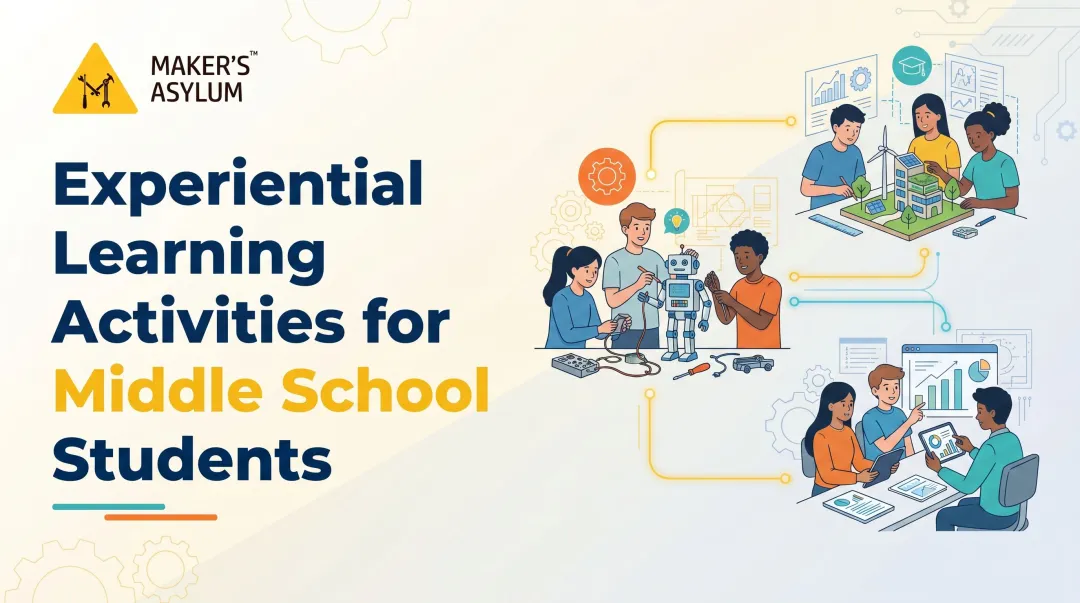
Experiential learning schools, particularly those centered on making and prototyping, are fundamentally reshaping education. Students who learn by doing aren't just absorbing information; they're developing the confidence, technical skills, and problem-solving mindset that traditional classrooms rarely cultivate. The difference shows up in university admissions, career readiness, and students' ability to tackle real-world challenges.
Key Takeaways
- Experiential learning prioritizes active participation over passive instruction — students gain knowledge by engaging hands-on with materials, tools, and problems
- Making — building physical and digital prototypes — is the deepest form of experiential learning, integrating multiple disciplines at once
- Research confirms that students in active learning environments perform better academically and are 1.5x less likely to fail
- Making-centred programs give students tangible portfolios, transferable skills, and real confidence
What Is Experiential Learning in Schools?
Experiential learning is a teaching approach rooted in "learning by doing." Instead of passively absorbing information through lectures and textbooks, students gain knowledge and skills through direct participation in meaningful activities. According to the Association for Experiential Education, this approach emphasizes learner agency, sustained reflection, and learning from natural consequences — fundamentally different from traditional instruction.
Examples of experiential learning include:
- Lab work and field research where students collect and analyze data firsthand
- Project-based challenges that require designing solutions to real problems
- Maker workshops where students prototype using tools like laser cutters and electronics
- Service learning that connects classroom concepts to community needs
How It Differs from Traditional Classrooms
Traditional schooling typically follows a lecture-test cycle: teachers deliver content, students memorize it, and exams measure recall. Experiential learning flips this model. Students encounter challenges, explore solutions through hands-on experimentation, reflect on what worked or failed, and apply insights to new situations.
The 12 Principles of Practice outlined by the Association for Experiential Education highlight active engagement, risk-taking, authentic problem-solving, and iterative critique — elements largely absent from conventional classrooms. Understanding where different programs fall on that spectrum helps clarify which approaches go deepest.
The Spectrum of Experiential Approaches
Not all experiential learning looks the same. Classroom projects and simulations occupy the lighter end — useful, but limited in scope. Moving deeper, you find outdoor schools, expeditionary programs, and full maker environments. Maker-based programs sit at the far end of that spectrum: they demand sustained, multi-disciplinary engagement with real constraints and tangible outcomes, producing something physical that either works or doesn't.
The Science Behind "Learning by Doing"
Dewey's Foundational Philosophy
John Dewey believed hands-on participation leads to deeper engagement and stronger learning outcomes — a conviction so strong that he founded the University of Chicago Laboratory Schools in January 1896 to prove it. Dewey's vision was radical for its time: a cooperative community where students learn through creative problem-solving and genuine responsibility, not rote memorization.
Kolb's Experiential Learning Cycle
David Kolb formalized how experiential learning works through his four-stage cycle:
- Concrete Experience — doing something (building a prototype, conducting an experiment)
- Reflective Observation — thinking about what happened and why
- Abstract Conceptualization — drawing conclusions and forming principles
- Active Experimentation — testing those conclusions in new situations
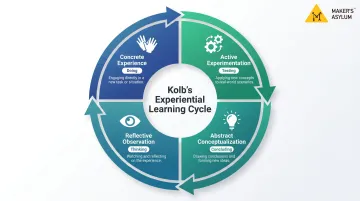
Cycling through all four stages produces deeper knowledge retention than content delivery alone. Students don't just memorize facts; they internalize principles through repeated application and reflection.
Research-Backed Outcomes
The research is clear. A 2014 meta-analysis published in PNAS reviewed 225 studies on active learning. Exam scores improved by ~6%, while failure rates dropped from 33.8% in lecture-only classes to 21.8% in active learning settings.
Project-based learning shows similar results:
- 8–11 percentage point gains on standardized assessments (Lucas Education Research)
- Benefits extend to English learners across math, science, and literacy
- Outcomes hold across diverse student populations, not just high performers
Why Doing Works Better Than Listening
Physically engaging with materials activates more areas of the brain than passive listening. When students build, test, and iterate, they encounter real consequences: a circuit that doesn't work, a design that fails under load. That immediate feedback accelerates learning in a way a lecture simply cannot. Skills practiced through real application also transfer better to new situations, because they're embedded in context rather than stored as abstract facts.
India's National Education Policy Aligns with Experiential Principles
This cognitive case for doing-over-listening has shaped national policy too. India's National Education Policy 2020 prioritizes experiential methods, committing to reduce rote learning and create space for "critical thinking and more holistic, inquiry-based, discovery-based, discussion-based, and analysis-based learning." Assessment will shift from memorization to competency-based evaluation that tests "higher-order skills, such as analysis, critical thinking, and conceptual clarity."
NEP 2020 mandates that "experiential learning will be adopted, including hands-on learning, arts-integrated and sports-integrated education" at all stages. Experiential methods have moved from classroom experiments to national policy mandate.
Making as the Ultimate Form of Experiential Learning
Why Making Is a Complete Learning Loop
Making — actually designing, building, testing, and iterating physical or digital projects — represents experiential learning at its fullest. It forces students to apply knowledge from multiple disciplines simultaneously.
Building a river cleanup device, for example, requires understanding buoyancy (physics), circuit design (electronics), environmental science (pollution dynamics), and mechanical systems (propulsion). This STEAM integration happens organically, driven by the problem itself rather than artificial curriculum boundaries.
Real constraints force real problem-solving. You can't fake a working prototype. If the motor stalls or the sensor doesn't trigger, the student must diagnose why and iterate — precisely the cycle Kolb described.
What a Maker Environment Looks Like
A well-designed maker-based learning environment provides:
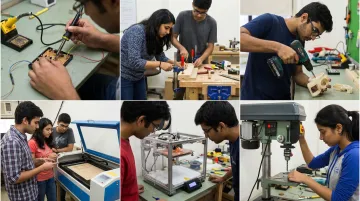
- Professional-grade tools — laser cutters, 3D printers, electronics benches, woodworking equipment, CAD software
- Real-world challenges — projects tied to actual community problems, not classroom simulations
- Culture of fearless experimentation — where breaking things is part of the process, not a failure
- Mentorship from practitioners — guidance from working engineers, designers, and makers, not just classroom instructors
The difference between a school with a makerspace and a school built around making is profound. The former adds a room with equipment; the latter makes creating things central to how students learn.
The SDG and Purpose-Based Dimension
When making connects to solving real societal problems — clean water access, assistive technology for disabilities, sustainable energy — students develop not just technical skills but a sense of agency and purpose. The UNDP India SDG School model exemplifies this, where youth develop solutions aligned to UN Sustainable Development Goals through hands-on projects.
Purpose-driven making ensures students encounter genuine audiences and stakeholders, not just teachers. When you're building a device for sewage workers or designing accessibility solutions, the feedback loop is immediate and meaningful.
Maker's Asylum: A Concrete Example
Maker's Asylum's Innovation School demonstrates this model in practice. Students aged 13+ work on interdisciplinary STEAM projects inside a 10,000+ square foot makerspace in Goa, mentored by hardware engineers and experienced makers.
The program combines 50-60 hours of online skill-building (CAD, electronics, IoT, robotics) with a 7-day physical residency where students build functional prototypes.
Students have developed:
- A low-cost river cleanup device using remote-controlled buoyancy systems
- Solar-powered IoT devices for off-grid communities
- Assistive music technology for individuals with limited mobility
The program grew from 30 students in 2021 to 400+ students spanning 50+ cities and 40+ countries, with alumni accepted to MIT, Stanford, Cambridge, IIT, and other top universities — proof that a hands-on portfolio opens doors that grades alone cannot.
Real Outcomes: What Students Gain from Maker-Based Experiential Learning
Confidence and a Maker Identity
Students who build real things develop a different relationship with challenges. Instead of waiting to be told the answer, they default to trying — adjusting, testing, and trying again. That shift from passive learner to active builder is one of the most durable outcomes of maker education.
When a student successfully troubleshoots a circuit, debugs code, or iterates a prototype until it works, they carry that confidence into every challenge that follows.
Portfolio Development and University Advantage
Unlike test scores, a portfolio of real projects demonstrates initiative, creative problem-solving, and technical range. MIT's admissions office explicitly welcomes Maker Portfolios, describing them as showcasing "engineering or crafting projects... substantial, original, and technically creative."
Top universities increasingly value evidence of independent work and making ability. A student who has designed, prototyped, and tested a functional device presents something most applicants simply cannot: proof of doing.
Career Discovery and Readiness for the Future of Work
Hands-on programs expose students to real disciplines — hardware engineering, product design, fabrication, software integration — and help them identify what genuinely excites them before committing to a career path. No aptitude test replicates that.
The World Economic Forum's Future of Jobs Report 2025 identifies the skills rising in importance as:
- Analytical and creative thinking
- Resilience and adaptability
- Technological literacy
- Curiosity and lifelong learning
Making cultivates all of them — through practice, not instruction.
Transferable Skills — Critical Thinking, Collaboration, and Iteration
Making projects require students to:
- Work in teams and negotiate design decisions
- Manage ambiguity when problems don't have clear solutions
- Accept feedback and revise based on testing
- Persist through failure and iterate toward success
Employers consistently identify communication, teamwork, critical thinking, and professionalism as the most in-demand competencies. Maker programs build these competencies through repeated real-world practice — the kind that sticks long after a program ends.
What to Look for in an Experiential Learning School or Program
Not every program that calls itself "experiential" delivers the real thing. Here's what separates genuine programs from surface-level ones.
Key Markers of a Genuinely Experiential School
- Connects students to real problems — designing solutions for actual communities or stakeholders, not classroom simulations
- Brings in practitioners as mentors — active makers, engineers, or designers, not only credentialed instructors
- Assesses through demonstrated outcomes — portfolios, presentations, and functional prototypes alongside (or instead of) standardized tests
- Provides environments built for building — access to professional tools, materials, and maker resources
PBLWorks' Gold Standard PBL emphasizes challenging problems, sustained inquiry, authenticity, student voice, reflection, critique, and public products — all essential markers of quality.
Questions Parents and Students Should Ask
- Do students produce real projects, or just study them?
- Are facilitators active makers themselves, or primarily instructors?
- Can graduates show a portfolio of completed work?
- Where are alumni now — universities, startups, careers in STEAM fields?
- Is making the foundation of learning, or an occasional add-on?
Example: Maker's Asylum's Purpose-Built Ecosystem
Maker's Asylum runs three core programs — Innovation School, SDG School, and Maker Skills courses — where making is the foundation, not a supplement. Students work in a functioning makerspace with access to:
- Laser cutters and 3D printers
- Electronics labs and woodworking facilities
- Mentorship from hardware engineers and experienced makers
No classroom instructors. Practitioners only.
400+ alumni span 40+ countries, with placements at top institutions globally. Partnerships with UNESCO, UNDP, and universities worldwide open pathways well beyond the program itself.
Frequently Asked Questions
What is experiential learning in schools?
Experiential learning is a "learning by doing" approach where students build knowledge through direct, hands-on participation in meaningful activities. It contrasts with passive instruction methods like lectures and emphasizes active engagement, reflection, and real-world problem-solving through labs, projects, fieldwork, and maker challenges.
What are some hands-on learning examples?
Hands-on learning examples include building a working prototype in a makerspace, conducting original field research in local ecosystems, designing a solution to a community problem like water access, participating in an archaeological dig, or completing a project-based STEAM challenge where students create functional devices or systems.
What are the 4 stages of experiential learning?
Kolb's experiential learning cycle consists of four stages: Concrete Experience, Reflective Observation, Abstract Conceptualization, and Active Experimentation. Moving through all four stages — doing, reflecting, concluding, then testing — produces deeper learning than instruction alone.
What type of school is best for a gifted child?
Gifted children often thrive in environments with open-ended challenges, mastery-based progression, and real-world complexity. Experiential and project-based schools — including makerspaces and innovation programs — let high-ability learners explore topics deeply and tackle genuinely difficult problems.
What are the 4 types of project method?
Kilpatrick's 1918 project method identifies four types: constructive projects (making or producing something tangible), appreciative projects (enjoying or evaluating aesthetic experiences), problem-type projects (solving an intellectual or technical problem), and drill/practice projects (mastering a specific skill through repetition and application).
What are the 4 parts of NEP?
India's National Education Policy 2020 covers four key areas: school education, higher education reform, vocational education integration, and teacher education and training. The policy explicitly promotes experiential, competency-based, and multidisciplinary learning at every stage.
The research on experiential learning is consistent: students who build, prototype, and reflect retain more, apply knowledge faster, and develop the problem-solving instincts that formal instruction rarely teaches. For parents comparing schools or educators rethinking their classrooms, that's not a minor consideration — it's the whole point. The question isn't whether making belongs in education. It's how soon students get access to it.