This question matters more now than ever. The term "innovation school" gets used in many ways — from specific administrative designations for independently managed public schools to entire learning philosophies centered on student agency and making. This guide cuts through the confusion to explain what innovation schools mean in practice for students and parents.
You'll learn what defines an innovation school, the key traits that set these programs apart, what students actually experience day-to-day, and how to evaluate whether this model is the right fit for your child.
Key Takeaways
- Innovation schools replace passive instruction with hands-on, student-driven problem-solving focused on real-world challenges
- Students build portfolios of tangible work instead of relying solely on test scores and grades
- Core skills include critical thinking, creativity, collaboration, and communication — all increasingly valued in university admissions and hiring
- Graduates are increasingly well-positioned for competitive university admissions and future careers
- The label "innovation school" varies widely; this guide helps you separate substance from buzzwords
What Is an Innovation School?
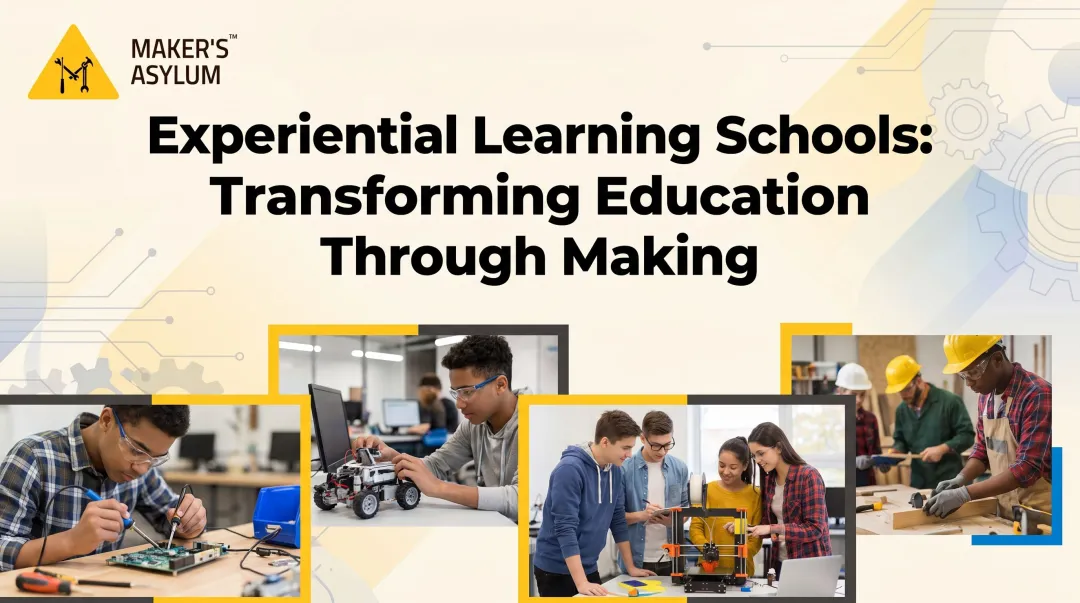
An innovation school is a learning environment that fundamentally redesigns how education is delivered. Instead of passive content transfer — lectures, textbooks, memorization — these schools center on active, project-based, purpose-driven learning where students tackle real-world problems.
The term is used in two broad contexts. First, as an administrative designation: in some US districts like Massachusetts, "innovation school" refers to independently managed public schools granted autonomy over curriculum, staffing, budget, and schedule while remaining within the district. Under Massachusetts General Law Chapter 71, Section 92, innovation schools can waive collective bargaining agreements and district policies to create flexible learning environments.
Second, innovation school describes a philosophy of education centered on student agency, making, and inquiry — where learning happens through building, experimenting, and iterating, not worksheets and standardized tests.
The core philosophical shift is straightforward: traditional schools ask what students need to memorize; innovation schools ask what students can build or solve. This changes how students develop. Instead of recalling information, they apply knowledge to design solutions, develop prototypes, and present their thinking — skills that transfer directly to university and careers.
Innovation schools emerged from dissatisfaction with the industrial model of education. Their intellectual lineage runs deep, drawing on movements like maker education, project-based learning (PBL), design thinking, and Genius Hour.
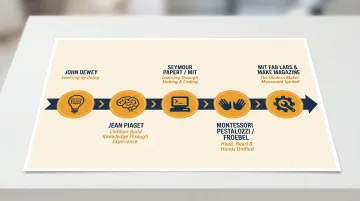
The pedagogical roots trace back centuries, through thinkers and movements including:
- John Dewey — "learning by doing" as the foundation of progressive education
- Jean Piaget — constructivism: children build understanding through experience
- Seymour Papert (MIT) — constructionism: learning happens best when making shareable things
- Pestalozzi → Montessori → Froebel — "head, heart, and hands" philosophy evolving across centuries
- MIT's Fab Labs (now 2,500+ globally) and Make Magazine (founded 2005) — the modern maker movement taking institutional form
Who are innovation schools for? Often students who are curious, hands-on, or disengaged by traditional schooling. These schools increasingly make a case for all learners — at a time when 39% of workers' core skills will change by 2030, the question isn't whether students need these skills, but whether their school is building them.
Core Characteristics That Define an Innovation School
Student-Centered Learning
In an innovation school, students are active participants in shaping their own learning. They choose projects, set goals, and direct inquiry — rather than moving through a fixed curriculum at the teacher's pace. That shift in ownership changes everything about how students engage with ideas.
Hands-On, Project-Based Work
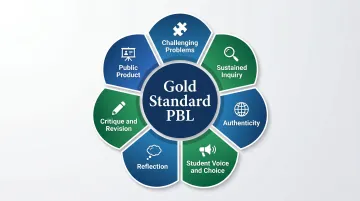
Learning happens through making, building, experimenting, and iterating. Students work on tangible projects with real-world relevance — often interdisciplinary, combining science, technology, engineering, art, and math (STEAM). PBLWorks' Gold Standard PBL framework identifies seven essential elements:
- Challenging Problems
- Sustained Inquiry
- Authenticity
- Student Voice and Choice
- Reflection
- Critique and Revision
- Public Product
Real-World Problem Solving
Projects address genuine problems in the community, society, or a field of student interest. Students aren't just "doing school for school's sake" — they're building solutions that matter. That sense of purpose is what makes the work memorable long after the project wraps up.
Collaboration Over Competition
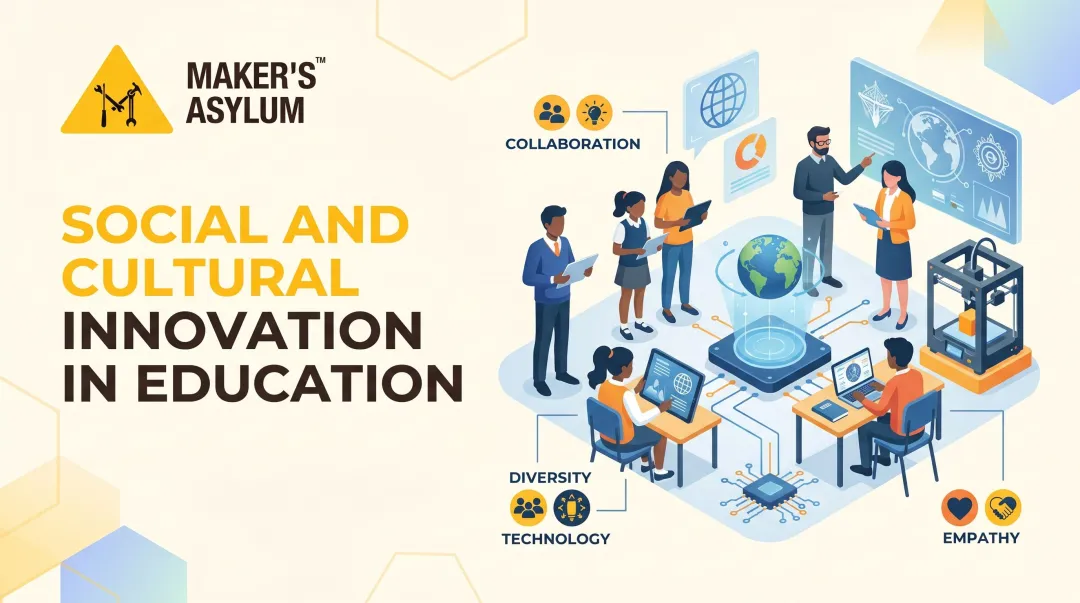
The culture shifts from individual competition to teamwork. Students share ideas, give and receive feedback, and build on each other's thinking. This mirrors how creative and professional work actually happens outside school.
Fearless Experimentation and Iteration
A "safe to fail" culture is essential. Students try things, break them, reflect, and try again. This builds persistence and comfort with uncertainty — two skills that matter far more in the real world than memorizing correct answers. Teachers assess the quality of thinking and the honesty of reflection, not just final outcomes.
These five characteristics aren't just theory. At Maker's Asylum's Innovation School in Goa, they're the operating model. Since launching with 30 students in 2021, the program has grown to over 400 students across 50+ cities and 40+ countries — learners who prototype ideas in STEAM disciplines and graduate with portfolios of real-world work.
What Students Actually Experience in an Innovation School
Typical Day vs. Traditional School Day
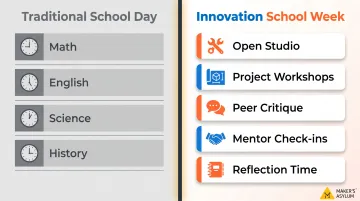
Forget fixed periods of math, then English, then science in isolation. Innovation school days are structured around project milestones, not subject periods. A typical week might include:
- Open studio time for hands-on making
- Project workshops where teams develop prototypes
- Peer critique sessions for feedback
- Mentor check-ins to guide progress
- Reflection time to document learning
Teachers act as facilitators or "mentor makers" — not lecturers. They push students to ask sharper questions, locate the right resources, and work through dead ends on their own before stepping in. The goal is to build problem-solving instincts, not dependence on instruction.
The Role of Projects and Portfolio Building
Projects are the primary unit of both learning and assessment. Students build, present, and reflect on their work across the program — and that body of work becomes a portfolio of evidence showing their skills and thinking over time.
Types of projects students work on:
- Designing solutions to community problems (pollution monitoring, accessibility tools)
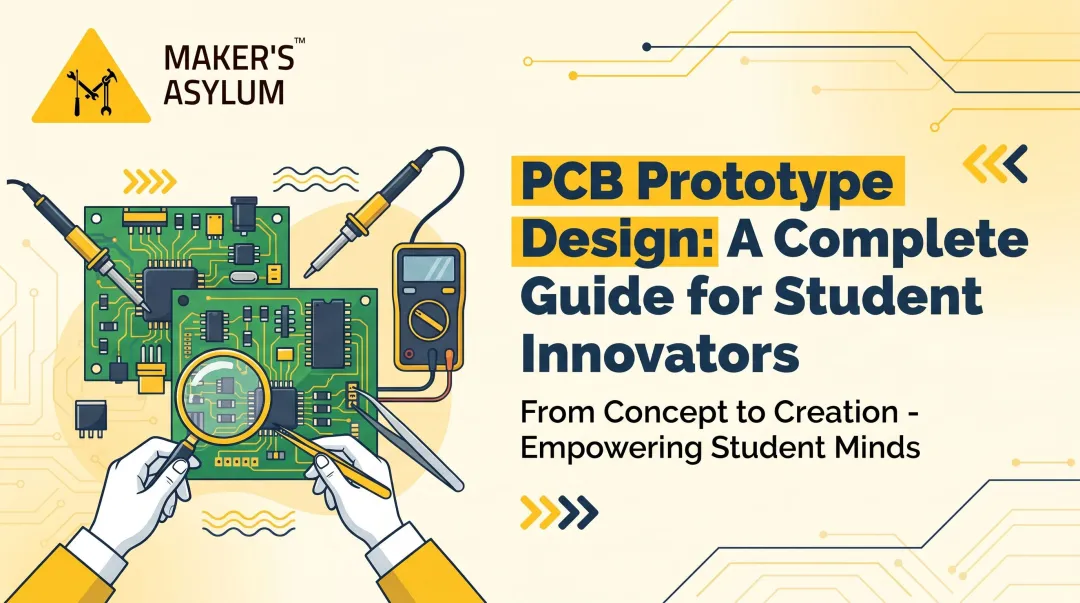
- Building functional prototypes (IoT devices, robotics, circuit boards)
- Creating media and interactive experiences (VR apps, games)
- Researching social issues and developing interventions
- Building tools that address real needs
Early projects build foundational skills; later ones tackle messier, open-ended problems where there's no single right answer. That progression is what makes the portfolio meaningful.
Top universities look for evidence of initiative, real-world problem-solving, and making — not just grades.
Stanford values "intellectual vitality" and depth over breadth. MIT seeks "hands-on" students aligned with its "Mind and Hand" motto. The Mastery Transcript Consortium — 400 schools offering portfolio-based alternative transcripts — has enabled students to gain admission to 170+ colleges. Innovation school portfolios are genuine assets for admissions, not just grade supplements.
Benefits of an Innovation School for Students and Parents
For Students: Skills That Employers Are Already Asking For
Research confirms that project-based and maker-centered learning develops the skills employers value most. The WEF Future of Jobs Report 2025 projects that 39% of workers' core skills will change by 2030, with analytical thinking (#1) and creative thinking (#4) topping employer demand.
Innovation schools are explicitly designed to cultivate the 4 C's: Critical Thinking, Communication, Collaboration, and Creativity — core competencies identified by the Partnership for 21st Century Learning.
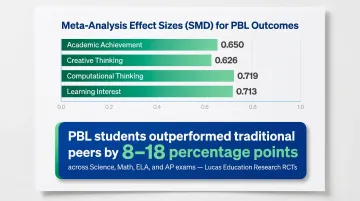
A meta-analysis of 66 studies found PBL produced moderately positive effects overall (SMD = 0.441), with the strongest impact on:
- Academic achievement (SMD = 0.650)
- Creative thinking (SMD = 0.626)
- Computational thinking (SMD = 0.719)
- Learning interest (SMD = 0.713)
Four randomized controlled trials funded by Lucas Education Research showed PBL students outperformed traditional peers by 8-18 percentage points across grades 2-12 in science, math, ELA, and AP exams.
These outcomes matter to parents too — and they translate directly into what families look for when choosing a program.
For Parents: What to Expect Beyond the Classroom
Innovation schools deliver on three things parents consistently care about:
- Builds genuine confidence — students practice trusting their ideas and treating failure as feedback, not a verdict
- Reveals real career interests through hands-on exploration across engineering, design, sustainability, and more
- Strengthens university applications with authentic project portfolios that go beyond grade transcripts
A common parent concern: "Will my child still cover the fundamentals?"
Yes. Innovation schools integrate core knowledge through projects. Students learn math, science, and literacy in context — often more deeply because they need it to solve a real problem. For example, designing a circuit board requires geometry, electrical physics, and technical writing. Building a sustainability solution involves data analysis, environmental science, and communication.
PBL was effective across all racial and socio-economic groups, with English language learners outperforming peers by 8-28 percentage points in language proficiency.
Innovation School vs. Traditional School
| Aspect | Traditional School | Innovation School |
|---|---|---|
| Teaching Method | Teacher-led lectures, textbook-driven instruction | Facilitated making, mentorship, student-driven inquiry |
| Assessment | Tests, quizzes, standardized exams | Portfolio, reflection, project presentations, peer critique |
| Curriculum | Fixed scope and sequence, siloed subjects | Flexible, interdisciplinary, project-driven |
| Student Role | Passive recipient of information | Active problem-solver and creator |
| Culture | Individual competition for grades | Collaboration, shared learning, collective intelligence |
Innovation schools are genuinely rigorous — just in a different way. Dr. Jen Gowers from Columbia Teachers College frames it as "rigorous, real-world, relevant learning," drawing a sharp line between superficial "dessert projects" (tacked on at the end of a unit) and robust PBL where projects drive the lesson. As Dewey argued, real rigor is "doing" that demands thinking — sustained attention, self-direction, iteration, and the ability to explain your reasoning.
Important note: Innovation schools may feel uncomfortable at first for students accustomed to being told exactly what to do. This adjustment period is part of the learning, not a sign the model is failing.
How to Choose the Right Innovation School for Your Child
Evaluation Criteria
Use these five questions to evaluate whether an innovation school is genuinely innovative or using the label superficially:
1. Does it have real project-based work? Ask: "What did your students make last year?" Look for sustained, complex projects — not activities tacked onto traditional lessons. Projects should address real problems and result in tangible outcomes.
2. Are students building visible portfolios? Strong innovation schools emphasize documentation and portfolio development. Students should be able to show what they've created and explain their process.
3. Is there a culture of mentorship and iteration? Ask: "What happens when a student's project fails?" The answer should reflect a safe space for experimentation, with mentors guiding reflection and revision.
4. Are graduates going on to meaningful next steps? Check alumni outcomes. Are they gaining admission to strong universities? Pursuing careers aligned with their interests? This indicates the program delivers real value.
5. How is learning assessed? If the answer is primarily "tests and grades," it's not truly project-based. Look for reflection, critique, public presentations, and portfolio review.
Questions to Ask During School Visits
Print this list and bring it to your visit — the answers will tell you more than any brochure:
- "What does a typical week look like?" (Should describe project work, not just subject periods)
- "Where do your graduates go?" (Should provide university placements or career pathways)
- "Can I see a student portfolio from last year?"
A Strong Example: Maker's Asylum's Innovation School
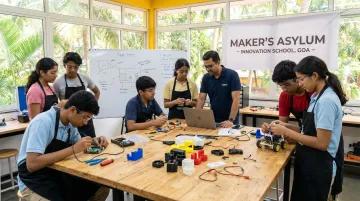
To see these criteria in action, Maker's Asylum's Innovation School is a useful benchmark. Built on "Learning By Making," the program combines 50 hours of online skill-building with a 7-day hands-on residency in Goa. Students work in STEAM labs with real mentorship from experienced makers, developing functional prototypes of solutions to real-world problems.
Since 2021, the program has grown from 30 to 400+ students across 40+ countries and 50+ cities. Alumni have been admitted to MIT, Stanford, Columbia, Imperial College London, Cornell, and other top universities — a track record that reflects what rigorous portfolio-building and hands-on learning can produce.
Frequently Asked Questions
What is an innovative school?
An innovative school redesigns the learning experience around student agency, real-world problem-solving, and hands-on creation. It moves beyond passive instruction to develop skills that matter in the modern world through project-based, experiential learning.
What are the 4 C's of innovation?
The 4 C's are Critical Thinking, Communication, Collaboration, and Creativity — core competencies innovation schools explicitly cultivate through project-based and experiential learning. These were identified by the Partnership for 21st Century Learning as essential skills for future success.
What age is innovation school for?
Innovation schools serve a range of ages, with many programs targeting middle and high school students (grades 7–12 / ages 13+). This is when self-directed, project-based learning can be most impactful for building portfolios and developing future readiness.
How is innovation school different from a regular school?
Innovation schools shift from teacher-led, exam-focused learning to student-driven, project-based, hands-on education. The goal is building real skills and a portfolio of work, not just passing tests or earning grades.
Does attending an innovation school help with university admissions?
Yes. Top universities increasingly value initiative, real-world projects, and creative problem-solving — exactly what innovation school students demonstrate through portfolios. Stanford, MIT, and 170+ colleges already accept portfolio-based transcripts in place of traditional grades.
Is an innovation school right for every child?
Curious, hands-on students — especially those who feel disengaged by traditional schooling — tend to thrive most. Most good programs ease the transition to self-directed learning, building confidence alongside skills.
Final Thoughts
Innovation schools are grounded in a centuries-long pedagogical tradition: people learn best by making, not watching. As employers increasingly hire for problem-solving ability and demonstrated work over exam scores, the portfolio a student builds at an innovation school becomes a genuine competitive asset.
If your child lights up when building, questioning, and solving problems, an innovation school might be the environment where they finally feel at home.