A portfolio transforms your academic experience from a list of grades into a compelling story of skills, curiosity, and real work. It shows who you are as a thinker and maker, not just a test-taker. This guide covers what a student portfolio is, why it matters, what to include, and how to start building one—especially relevant for students in STEAM fields who learn by making and solving real problems.
Key Takeaways
- A portfolio shows what you can do through documented projects, not just what you scored
- Useful for university admissions, internships, scholarships, and STEAM program applications
- Strong portfolios combine work samples, process docs, reflections, and a personal statement
- Hands-on projects create the strongest portfolio content: a documented prototype beats undocumented coursework every time
- Start early, document as you go, and keep it updated
What Is a Student Portfolio?
A student portfolio is a curated collection of your best work that demonstrates your skills, growth, and thinking process. Unlike a transcript that lists grades or a CV that summarizes experiences in bullet points, a portfolio shows the actual work—projects you've built, problems you've solved, and how your thinking evolved along the way.
Portfolios take multiple forms depending on your field and audience. Common formats include:
- A digital website or personal domain
- A PDF document or presentation deck
- A physical binder with printed work samples
- Platform-hosted collections like Behance or Google Sites
STEAM students typically need digital-first portfolios, since most universities now require online submissions through platforms like SlideRoom or institution-specific portals.
A portfolio goes further than a CV. Where a CV tells reviewers what you did — "Built an air quality monitoring device using Arduino" — a portfolio shows the device itself and your design process. It captures the iterations you made and what you learned when your first version failed. That evidence makes your capabilities tangible, not abstract.
Why Your Portfolio Matters More Than You Think
Universities Want Differentiated Evidence of Ability
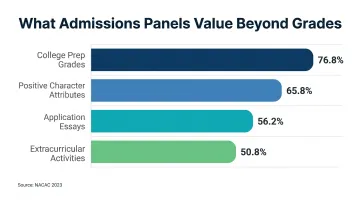
Admissions panels review hundreds of applications with identical 4.0 GPAs and similar test scores. NACAC data shows academic grades still dominate (76.8% of panels rate college prep grades as considerably important), but holistic factors carry real weight too:
- 65.8% value positive character attributes
- 56.2% value application essays
- 50.8% value extracurricular activities
A portfolio gives you concrete, differentiated proof of initiative — the kind a grades-only application simply cannot provide.
MIT explicitly accepts optional Maker Portfolios for applicants with "substantial, original, and technically creative" engineering projects. The admissions team reviews these portfolios looking for build process documentation—evidence of how you think and iterate, not just polished final products. For students applying to competitive STEAM programs globally, documented maker projects speak directly to what these institutions want to develop.
Employers Prioritise Skills-Based Hiring
Here's the disconnect most students miss: NACE's Job Outlook 2026 survey found 70% of employers now use skills-based hiring (up from 65% the year before), yet fewer than 40% of students even know the term. Employers are already judging you on demonstrated ability — most students just aren't prepared for it.
Internship recruiters evaluate portfolios to assess problem-solving ability, creative thinking, and hands-on execution—capabilities a CV cannot demonstrate. For students pursuing technical internships or early career opportunities, a portfolio closes this gap by showing actual work rather than just claiming skills.
Building Metacognitive Skills Through Reflection
Creating a portfolio forces you to evaluate what you've learned, what you're proud of, and where you want to grow. Research by Gencel (2017) found portfolio assessment produced statistically significant metacognitive skill gains compared to traditional assessment, with students reporting improvements in self-assessment, questioning, and awareness of their own learning process.
This reflective practice builds the "regulation of cognition" that helps you plan, monitor, and evaluate your own learning—skills that strengthen future academic performance and preparation for internships and real work experience.
Your Portfolio as Personal Brand
A well-maintained portfolio is your living professional identity. It's especially valuable when pursuing freelance work, competitions, scholarships, or community-driven opportunities.
For STEAM students, it's often the only accurate record of what you've actually built. A transcript shows a grade; a portfolio shows a working prototype, a documented design process, and the thinking behind every iteration.
What Should Be Included in a Student Portfolio?
Personal Introduction
A short, authentic bio that tells readers who you are, what you care about, and where you're headed. This should feel like a real person wrote it—not a formal cover letter. Keep it conversational and genuine.
Work Samples and Projects
The core of any portfolio. Include your strongest, most relevant projects—not everything you've ever made. Quality beats quantity every time. Choose projects based on your audience: a design school wants different evidence than a tech startup internship.
How many pieces? University guidance varies:
- MIT Maker Portfolios: Up to 25 media attachments
- MassArt: 12-15 pieces completed within the past two years
- Goldsmiths Design: 2-3 full projects shown from brief through resolution
- AP Art & Design: 15 images for Sustained Investigation
Aim for 10-25 pieces that show range and relevance. Lead with your strongest work, close with your second-strongest, and let the middle carry the journey.
Process Documentation
Showing the journey—sketches, iterations, failed attempts, revisions—is often more impressive than a polished final product alone. MIT explicitly states: "We are more interested in your build process than your end results."
Process documentation might include:
- Initial sketches and brainstorming notes
- Technical drawings with measurements and specifications
- Photographs of prototypes at different development stages
- Failed experiments with explanations of what you learned
- Version comparisons showing design evolution
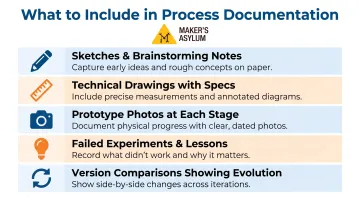
This is especially valuable for maker, design, and engineering portfolios where thinking process matters as much as outcome.
Reflections and Learnings
For each key project, include a short description covering:
- What you set out to do
- Challenges you faced
- What you learned from the experience
- How you'd approach it differently next time
This demonstrates maturity and a growth mindset. The College Board's AP Art and Design program requires written explanations (600 characters maximum) describing how investigations "developed through practice, experimentation, and revision"—because the learning process matters.
Supporting Materials
Beyond your projects and reflections, some documents round out the picture of who you are:
- Resume or CV
- Certifications and awards
- Letters of recommendation
- Relevant academic transcripts
- Competition results or publications
What to Leave Out
Avoid including every piece of work "just in case." An unfocused, cluttered portfolio weakens the overall impression. If a project doesn't represent your best thinking or doesn't serve the portfolio's goal, drop it. Every piece should earn its place.
Types of Student Portfolios
Format Types
Digital portfolios are now standard for university applications. MIT, MassArt, and the University of Edinburgh all require digital-only submissions through platforms like SlideRoom or institution-specific portals.
Physical portfolios still matter for in-person interviews or presentations, but most students today need a digital version first.
Purpose Types
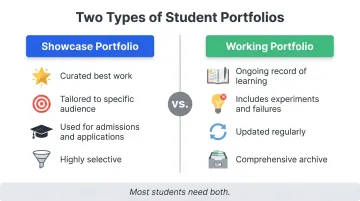
The two main purpose-driven types work differently:
- Showcase portfolios present your curated best work for applications or admissions — highly selective and tailored to a specific audience
- Working portfolios maintain an ongoing record of learning and growth, including experiments that didn't work out as planned
Most students need both. Keep a comprehensive working portfolio updated regularly, then pull from it to build targeted showcase portfolios for specific applications.
How to Build a Portfolio That Actually Gets Noticed
Start With Your Goal and Audience
Before gathering any materials, define who will read this portfolio and what they need to see. A portfolio for a fine arts school looks completely different from one for a tech startup internship. Defining the goal first shapes every decision—what to include, how to present it, and what story to tell.
Collect and Curate Your Work
Document your work as you go—photograph projects, save drafts, write short notes after completing something. This makes curation easier later.
Apply a rigorous selection process:
- Choose 10-25 pieces that show range and relevance
- Lead with your strongest work
- Close with your second-strongest
- Let the middle carry the journey
- Remove anything that doesn't represent your best thinking
Design for Clarity, Not Decoration
Your portfolio's layout should help the work shine, not compete with it. Use:
- Clean, consistent visual structure
- Coherent colour scheme
- Legible fonts
- Ample white space
- Mobile and tablet compatibility for digital portfolios
University admissions reviewers and internship coordinators often skim portfolios quickly across different devices — run a quick check on mobile and tablet before you submit.
Seek Feedback and Keep It Updated
Before finalising, share a draft with a mentor, teacher, or peer. Ask them specifically:
- Is the work clearly presented?
- Does the order make sense?
- Are my reflections authentic and insightful?
- What's missing?
A portfolio isn't a one-time submission. Revisit it every few months — swap out weaker older pieces as your work improves, and add projects that reflect where you're headed next.
Why Hands-On Projects Make the Strongest Portfolios
Projects rooted in real-world problem-solving—building something, designing a solution, prototyping an idea—produce far more compelling portfolio content than coursework alone. Research by Zhang and Ma (2023) analysed 66 studies and found project-based learning produces strong positive effects on student outcomes, with the highest effect size (0.720) at the high school level.
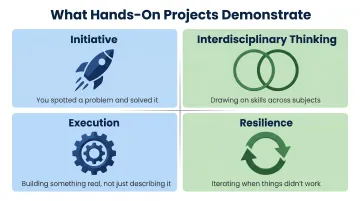
These projects demonstrate:
- Initiative — you spotted a problem and decided to solve it
- Interdisciplinary thinking, drawing on skills across multiple subjects
- Execution: the ability to build something real, not just describe it
- Resilience, shown through how you iterated when things didn't work
For students applying to innovation-focused universities, a portfolio filled with documented maker projects, STEAM experiments, or sustainability-linked challenges speaks directly to what admissions teams want to see. At Maker's Asylum's Innovation School, students work through exactly these kinds of projects — tackling real challenges and graduating with documented proof of their skills and thinking process.
Practical takeaway: If you haven't taken on project-based work yet, start now. One well-documented project can be more powerful than a dozen undocumented assignments.
Document the full journey: capture initial sketches, photograph failed prototypes, note what you learned when things went wrong, and show how your thinking evolved.
Frequently Asked Questions
What is a student portfolio?
A student portfolio is a curated collection of work, projects, and reflections that demonstrates your skills, growth, and thinking process. Unlike grades or transcripts that show what you scored, a portfolio shows what you can actually do through tangible evidence of your capabilities.
What are student portfolios used for?
Portfolios serve multiple purposes: university admissions (especially for competitive STEAM programs), internship and job applications, scholarship applications, tracking your own growth, and personal branding. They give admissions teams and employers concrete evidence of your abilities that a standard application simply cannot match.
What should be included in a student portfolio?
Key elements include a personal statement, work samples and projects (10-25 pieces), process documentation showing your thinking and iterations, reflections on what you learned, and supporting materials like a CV or recommendations. Process documentation matters just as much as the final product.
What are student portfolio examples?
Portfolios vary by field. A STEAM student might include documented maker projects, circuit boards, 3D-printed prototypes, and IoT devices alongside build logs. A design student might show visual work, process sketches, and iteration documentation. Format and depth depend on your discipline and who's reviewing it.
Is a portfolio the same as a CV?
No. A CV lists credentials and experiences in text form—what you did, where you studied, what you achieved. A portfolio shows the actual work behind those experiences, making it concrete proof of ability rather than just claims about skills.