Introduction
University admissions officers spend approximately 8 to 12 minutes reviewing each application, often examining 30–40 submissions per day. In that narrow window, a well-built portfolio can mean the difference between blending in and standing out. Yet many students either start too late or include the wrong things—treating portfolios as assignment dumps rather than curated showcases of skill and impact.
Building a strong portfolio is harder than it looks. A random collection of certificates looks nothing like a story-driven showcase of real-world problem-solving. According to NACAC's 2023 State of College Admission report, roughly 40% of surveyed colleges assign at least some importance to portfolios in their admissions decisions. That share is large enough that the right portfolio can tip the outcome in your favour.
This article covers a complete portfolio checklist, a step-by-step building process, what actually impresses admissions teams, and the most common mistakes students make.
Key Takeaways
- A student portfolio is a curated collection of your best work—not everything you've done
- Real-world documented projects outweigh certificates and grades
- Start building from Grade 9 and update continuously
- Universities value evidence of process and problem-solving, not just polished outcomes
- Digital portfolios are increasingly preferred — keep yours clean and easy to navigate
What Is a Student Portfolio and Why Does It Matter?
A student portfolio is a purposeful, curated collection of work samples, projects, achievements, and reflections that demonstrates who you are as a learner, thinker, and doer—beyond what a transcript or resume can show. Educational researcher Paulson defines it as a collection that "exhibits the student's efforts, progress, and achievements," one that requires "student participation in selecting contents" and "evidence of student self-reflection."
Portfolios carry real weight with admissions teams. Research shows that 40% of NACAC member colleges assign at least some importance to portfolios in admissions decisions.
That number matters more in certain fields. STEAM, design, and innovation-focused programs increasingly expect portfolio submissions — and universities like MIT, Stanford, Parsons, and RISD formally review them as part of applications.
Portfolio vs. Resume: Understanding the Difference
A resume lists what you've done. A portfolio proves it — with evidence, context, and demonstrated skill.
Consider the difference:
- Resume: "Interested in environmental science and research"
- Portfolio: The water quality monitoring device you built to test your local river, with your design process, iterations, and results documented
That kind of evidence shows admissions teams something a grade or test score simply cannot.
The Student Portfolio Checklist: What to Include
A strong portfolio covers six core categories: profile, academics, projects, activities, skills, and recognitions. Gather and organise your materials under each before you start building — this prevents gaps and makes the final result far more coherent.
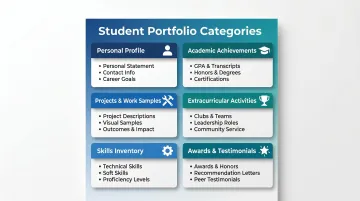
Personal Profile and Introduction
- Write a 3–5 sentence professional bio covering who you are, what you're passionate about, and what drives your work
- Add a professional-quality photo and contact email
- Include relevant links (LinkedIn, GitHub, personal website) where applicable
- Keep personal details like phone numbers and home addresses private
Academic Achievements
Academic credentials provide the foundation that contextualises the rest of your portfolio:
- Relevant coursework in your field of interest
- GPA (if strong—typically above 3.5)
- Academic honours and subject-specific awards
- Standardised test scores (if they strengthen your profile)
Projects and Work Samples
This is your most critical section. List all significant projects—school, personal, community, or maker-based—with complete documentation:
- Problem statement or challenge addressed
- Your specific role and contribution
- Process: tools used, iterations made, obstacles overcome
- Outcome or impact: what you learned, who benefited, what changed
Back each project with real evidence: photos, prototypes, code repositories, presentation files, or videos of experiments and builds. MIT's admissions guidance puts it directly: "We are more interested in your build process than your end results." Show how you think, not just what you finished.
Extracurricular Activities and Leadership
- Clubs, sports, community roles, and competitions
- Leadership positions with dates and duration
- 1–2 sentences on your specific contribution or what you led
Skills Inventory
Compile both technical and soft skills, but always pair each skill with evidence:
- Coding languages, lab equipment, design tools, and fabrication techniques
- Communication, teamwork, and problem-solving abilities
- Each skill linked to a specific project or experience that proves it
Saying "I know Python" is weak. Saying "I built a weather station using Python to collect and visualise temperature data" is strong.
Awards, Recognitions, and Testimonials
- Competition wins and certificates
- Community recognitions
- Short quotes or recommendations from teachers, mentors, or supervisors (with permission)
Third-party validation carries weight that self-reported achievements cannot — a single strong mentor quote can confirm qualities no bullet point fully conveys. Once you have all six categories ready, you're set to choose a format and platform that presents them well.
How to Build Your Student Portfolio Step by Step
Step 1: Gather Your Content First
Before opening any platform, create a dedicated folder and collect all materials by category. This prevents a scattered, incomplete portfolio and saves hours during the build phase. Organize files clearly—label images, name documents descriptively, and group related materials.
Step 2: Choose Your Format — Digital or Physical
For most university applications today, a digital portfolio is the recommended format. Digital portfolios are:
- Easier to share via link in applications
- Simple to update as you complete new work
- Accessible to admissions teams anywhere
- Integrated with platforms like SlideRoom (used by MIT, Stanford, and many others)
Free digital platforms include:
- Google Sites (simple, clean, good for beginners)
- Notion (flexible, great for process documentation)
- Behance or Adobe Portfolio (ideal for design and art)
- GitHub (essential for coding projects)
- Wix or Squarespace (more design control)
Physical portfolios are appropriate for art or design programs that specifically request them, but even these often require digital submission at the application stage.
Step 3: Write Context and Reflection for Each Item
For every project or work sample, write a brief description covering:
- The challenge or goal you were solving
- Your specific approach and contribution
- The outcome or result
- What you learned or how you grew from it
Universities want to see your thinking process, not just finished products.
Step 4: Curate, Organize, and Cut Ruthlessly
Organize items logically—consider grouping by category (robotics projects, community work, design) or by narrative theme (sustainability solutions, assistive technology).
Once organized, cut without mercy. A portfolio with 6 outstanding, well-documented pieces is far more effective than one with 20 underdeveloped entries. California College of the Arts puts it plainly: "Art school admissions departments would rather see a portfolio with 11 high-quality pieces that are thoughtful and expressive than one with 15 where the quality of work was uneven."
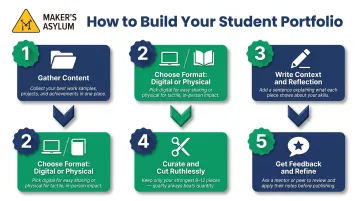
Step 5: Get Feedback and Refine Before Sharing
Share a draft with a trusted teacher, mentor, or peer and ask specific questions:
- Does it show clearly what I'm good at?
- Is anything confusing or missing context?
- Does it tell a coherent story from start to finish?
- Would you know what kind of program or opportunity I'm applying for?
Revise based on feedback before submitting or sharing publicly.
What Makes a Student Portfolio Stand Out to Universities?
Real-World Impact Over Completed Assignments
The biggest differentiator is evidence of real-world impact. Portfolios that show a student tackled a genuine problem—even a small one—and documented the process of solving it are consistently more compelling to admissions teams than collections of completed assignments.
For example, students at programs like Maker's Asylum's Innovation School build tangible solutions addressing real challenges: river cleanup devices using recycled materials, assistive technology for accessibility, air quality monitoring systems. These projects demonstrate initiative, creativity, and the ability to move from idea to prototype.
Show Process, Not Just Polished Outcomes
Admissions teams want to see how you think. UAL (University of the Arts London) explicitly asks applicants to show "how you research, develop and plan your ideas" and to include "the mistakes you've made along the way."
Document your making process with:
- Early sketches and brainstorming notes
- Failed attempts and what you learned from them
- Design iterations showing how you refined your solution
- Photos of prototypes at different stages
MIT's admissions blog asks: "How long did this take? Where did you learn to solder surface-mount components like that? How did you make that cake levitate?" They want technical narrative, not just finished products.
Tell a Coherent Story
The best portfolios aren't random collections—they tell a consistent story about who you are, what you care about, and where you're going. Identify your 1–2 core themes and ensure every selected piece reinforces that story.
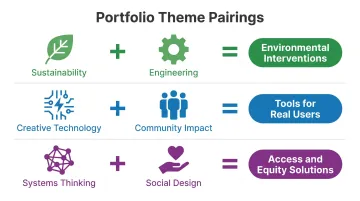
Strong theme pairings that universities respond to well include:
- Sustainability + engineering (documented environmental interventions)
- Creative technology + community impact (tools built for real users)
- Systems thinking + social design (solutions addressing access or equity)
Structured maker programs are designed around this approach — students work through the full cycle of problem identification, prototyping, iteration, and documentation over months, which means the portfolio builds itself in the process.
Common Mistakes Students Make with Their Portfolios
Starting Too Late and Rushing
Portfolios assembled in the final weeks before application deadlines are almost always thin on quality work. The best portfolios are built over one to two years, with projects documented as they happen. Most admissions advisors recommend starting as early as middle school — or at the very latest, in your first year of high school.
Including Everything Instead of Curating
Many students mistake volume for strength, including every assignment, certificate, and photo. A curated portfolio of 6–10 exceptional, well-described pieces consistently outperforms an overwhelming 30-item collection. Parsons School of Design explicitly discourages submitting "anime drawings, AutoCAD renderings, or images that are direct copies of another artist's work"—focus on original, meaningful work.
Skipping Descriptions and Reflection
Reviewers aren't just evaluating what you made — they're evaluating how you think. Uploading files without context leaves them guessing. Each item in your portfolio needs to answer three questions:
- What problem were you solving?
- How did you approach it?
- What was the outcome or impact?
MIT's admissions team puts it bluntly: "Don't throw spaghetti at the wall and hope that something sticks." A strong description turns a good project into a compelling story.
Frequently Asked Questions
What should a student portfolio include?
A student portfolio should include a personal bio, academic achievements, documented projects with process evidence, a skills inventory, extracurricular activities, and awards or testimonials. Projects with context and reflection are the most important elements—showing what you built, why it mattered, and how you approached the challenge.
What are the 4 types of portfolios?
The four main types are showcase (best work), process (learning journey and iterations), assessment (progress against goals), and hybrid (combining the others). Most student portfolios for university applications fall into the showcase or hybrid category.
When should students start building their portfolio?
Begin in Grade 9 (around age 14–15) and document projects as they happen. Trying to reconstruct process details and reflections in your final year before applications almost always falls short—the specifics are simply gone by then.
Should a student portfolio be digital or physical?
Digital is the standard for university admissions and professional purposes today—it's easier to share, update, and link to in applications. Physical portfolios are still appropriate for art or design programs that specifically request them, though even these often require digital submission initially.
How long should a student portfolio be?
Quality beats quantity. Aim for 6–10 well-documented, carefully selected pieces rather than an exhaustive collection. Reviewers rarely have time to examine more than 10–12 items, so focus on depth over breadth.
How do you make a student portfolio stand out to universities?
Emphasize real-world projects with documented process, a clear personal narrative connecting all pieces, and evidence of reflection and growth. Portfolios showing you solved a genuine problem or built something tangible are the most memorable—particularly when they show technical skill and real-world impact.