Introduction
Grades alone no longer tell the full story. Universities and employers increasingly look for evidence of real skills, creative thinking, and initiative, qualities that transcripts can't capture. According to the National Association for College Admission Counseling (NACAC), while 74.1% of institutions rate grades as "considerably important," only 6.5% assign the same weight to extracurricular activities. Yet at selective STEAM programs, portfolios become the primary differentiator when applicants have similar academic credentials. A strong portfolio gives reviewers something a transcript never can: evidence that you've actually built, tested, and shipped something.
Students who start building portfolios early gain a clear advantage. As Times Higher Education reports, global university admissions are "shifting towards holistic review," seeking "evidence of initiative, curiosity and long-term engagement" beyond grades.
Whether you're targeting MIT, Imperial College London, or IIT, the message is the same: don't just study problems. Show that you've solved them.
This guide covers the specific portfolio activities students can do, how to document them effectively, and how to present them in a format that makes an impression.
Key Takeaways
- A student portfolio is a curated collection of work samples, projects, and reflections that demonstrates skills, growth, and real-world problem-solving ability
- Strong portfolios show process, not just finished products — how you thought, iterated, and solved problems matters more than polish
- Project-based activities — prototyping, coding, research, creative work, community initiatives — make the most compelling portfolio pieces
- Start early, update regularly, and pick a format that fits your field — those three habits separate standout portfolios from average ones
What Makes a Strong Student Portfolio?
A portfolio that's just a folder of schoolwork won't stand out. Reviewers — whether university admissions officers or internship managers — look for evidence of initiative and real-world thinking, not just grades.
The strongest portfolios tell a coherent story: here's what I noticed, here's what I built, here's what I learned.
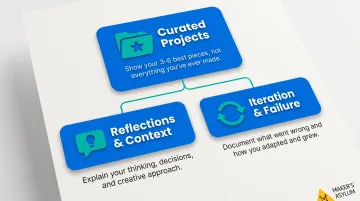
Every strong student portfolio includes three essential elements:
- Include your best 3-6 projects, not everything you've ever made — quality over quantity
- Add brief reflections explaining what you learned or how you approached a problem — context shows how you think, not just what you made
- Show at least one moment of failure or iteration — what went wrong, what you changed, and why it matters
MIT explicitly states it seeks applicants who are "not only planning to succeed but who are also not afraid to fail." Caltech's STEM Portfolio guidance emphasizes they want to know about "your connection and motivations to your project — not just the end result."
Here are six categories of portfolio activities to start building that kind of profile today.
Portfolio Activities to Build a Strong Profile
The activities below work because they generate both a finished artifact and a story — which is exactly what a strong portfolio needs.
Activity 1: Real-World Problem-Solving Projects
Working on projects tied to real problems — local community issues, environmental challenges, or SDG-aligned initiatives — creates portfolio entries that immediately show initiative and depth.
Examples include:
- Designing a low-cost water filter to address clean water access
- Creating a waste reduction plan for your school cafeteria
- Building a device to monitor air quality in your neighborhood
- Developing a solution for food insecurity or energy access
Programs like Maker's Asylum's Innovation School are built around exactly this kind of purpose-driven project work. Students have developed river cleanup devices using remote-controlled bots, underwater ROVs to retrieve ghost nets harming marine life, and water-saving toilet systems prototyped in local schools — all documented from problem identification through functional prototype.
What makes these projects portfolio-worthy: They demonstrate your ability to identify a genuine need, research it, and create a tangible solution. Admissions readers remember projects grounded in a real place and a real problem — not generic science fair topics.
Activity 2: Prototyping and Design Challenges
Building a physical or digital prototype — even a rough one — shows how you think through a problem, iterate on your ideas, and build something real. Students should document each version of the prototype, noting what changed and why.
What to include in your portfolio entry:
- Photos or videos of the prototype at different stages (initial sketch, first build, revised versions)
- A brief description of the problem it was solving
- A short reflection on what worked and what didn't — failure documentation is valuable
According to the 10-year longitudinal study by Brandeis University, 83% of FIRST Robotics alumni pursue STEM majors, and 51% of female alumni declare engineering or computer science — demonstrating how hands-on prototyping builds both skills and confidence. The program reached 785,000 students across 114 countries in 2023-2024, making it one of the most recognized portfolio-building activities globally.
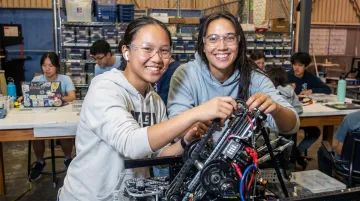
Those numbers matter because they show universities what sustained, hands-on building actually produces — document your own journey the same way: concept, first build, what broke, what improved.
Activity 3: Coding and Technology Projects
Building an app, website, game, or hardware project (such as an Arduino-based device) is one of the strongest portfolio activities available to students because the output is shareable, verifiable, and demonstrates technical competence.
Best practices for coding portfolios:
- Host your code on platforms like GitHub (which has over 7 million verified students on GitHub Education)
- Embed working demos where possible (live websites, video walkthroughs, playable prototypes)
- Write a short "project brief" explaining the purpose of the project, your role, and the tools you used
Caltech's STEM Portfolio explicitly accepts "coding projects" alongside research posters and robotics work, emphasizing "creativity and initiative" as assessment factors.
Example projects include:
- IoT devices controlled via mobile apps (smart lamps, environmental monitors)
- Games or interactive simulations built in Python or Unity
- Websites or web apps solving a specific problem
- Arduino or Raspberry Pi projects integrating hardware and code
Reviewers want to see your thinking, not just your output — so log the bugs you fixed, the features you added after testing, and the decisions you made along the way.
Activity 4: Research and Documentation Projects
Independent research — whether a structured science experiment, a social survey, or a comparative study — shows intellectual curiosity and academic rigor. The key is that you designed the inquiry, not just followed a teacher's instructions.
The 2025 Regeneron Science Talent Search received 2,471 entrants, the largest pool since 1967, competing for over $1.8 million in prizes. Selection criteria emphasize "originality and creativity of research, as well as achievement and leadership both inside and outside of the classroom."
The process journal or lab notebook is itself a portfolio artifact. It documents how you asked questions, gathered data, changed direction, and drew conclusions — making it far richer than a finished report alone.
Your research portfolio entry should include:
- Your research question or hypothesis
- Methodology and data collection process
- Results (including unexpected findings)
- Reflection on what you learned and what you'd do differently
MIT offers an optional Research Supplement for students who have "worked on a significant research project outside of high school classes," requiring an abstract and mentor recommendation. This demonstrates how seriously top institutions value independent research.
Activity 5: Creative and Arts-Based Projects
Creative work (visual art, graphic design, writing, music composition, filmmaking) belongs in any student's portfolio, even for students pursuing non-arts fields, because it signals communication ability, aesthetic thinking, and discipline.
Even Caltech offers a Non-STEM Portfolio accepting drawings, paintings, photography, videos, creative writing, poems, and even "cake decorating and baking." The admissions committee is direct about why: "Techers come to Caltech as people with layers, interests, and complex ideas."
Annotate your creative work: A short paragraph explaining the concept, the process, and the intended audience or effect turns a standalone piece into a genuine portfolio entry.
Examples include:
- Graphic design for a school event or community organization
- Short films or documentary projects
- Creative writing portfolios with reflections on your development as a writer
- Music compositions or performance recordings with context about your artistic choices
Parsons School of Design requires applicants to provide descriptions of process for "at least two of your favorite pieces," with evaluation based on "technical and conceptual abilities." They explicitly ask: "Does this work represent my viewpoint or tell a story?"
Activity 6: Community Impact Initiatives
Organizing a workshop, running a student club, leading a fundraiser, or contributing to an NGO or social project demonstrates leadership, collaboration, and a sense of responsibility beyond academics.
Document these initiatives with outcomes where possible:
- Number of participants reached
- Funds raised or resources mobilized
- Specific problems addressed or communities served
- Your specific role and contributions
Write a brief reflection on what you learned. According to NACAC data, "positive character attributes" hold "considerable importance" for 28.3% and "moderate importance" for 37.5% of admissions offices — the highest-rated non-academic factor.
Example initiatives:
- Tutoring programs you organized for younger students
- Environmental cleanup campaigns with measurable impact
- Fundraising for local NGOs with documented outcomes
- Student-led awareness campaigns on health, sustainability, or social issues
Outcomes matter most here. "I organized a tutoring program" is weak; "I ran 12 weekly sessions for 30 students, with 80% improving their grades" is a portfolio entry.
How to Document and Present Your Portfolio Work
The concept of "process documentation" is critical: capturing the journey of a project (notes, sketches, photos of early drafts, videos of experiments) is as important as saving the final result. Many students lose portfolio material simply because they don't document as they go.
Adopt the "project brief" format — a simple, repeatable structure for every entry:
- What was the problem or goal? State it clearly in 1-2 sentences
- What did you do? Describe your approach, tools, and process
- What was the result? Share the final outcome (even if incomplete)
- What did you learn or what would you do differently? Reflect honestly
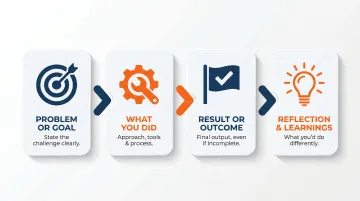
Keeping this format consistent across entries makes the portfolio easier to navigate and shows reviewers you think systematically.
Digital vs. physical portfolio formats:
- Personal website or platforms like Behance, Notion, or GitHub are ideal for most students because they are shareable and updatable
- Physical portfolios remain valuable for architecture, art, and product design students
- Choose the format that matches the field you're targeting
Once your format is set, reflection notes are what make the difference. A 3-5 sentence annotation per entry — explaining context, decisions, and what you learned — separates a portfolio that merely shows work from one that tells a story. Caltech makes this explicit: they want to know "your connection and motivations to your project — not just the end result." They even note that "submitting your portfolio is as simple as taking out your phone and taking a few pictures," — so the bar for starting is lower than most students assume.
Choosing the Right Portfolio Format for Your Goals
Map your portfolio format to your student goals:
| Field of Interest | Recommended Format | Why It Works |
|---|---|---|
| Web development, design, marketing | Personal website | Demonstrates web skills while presenting work |
| Coding and engineering | GitHub repositories | Shows technical proficiency and version control |
| Visual design and art | Behance or Dribbble | Industry-standard platforms with visual emphasis |
| Writing, research, education | Blog or Notion-based portfolio | Text-focused, easy to update and share |
| Architecture, product design, fine art | Physical binders or printed booklets | Allows tactile experience and large-format visuals |
Before deciding on a format, look at the portfolios of professionals or senior students in your target field. This gives you a benchmark for quality and structure before you begin building your own.
Institutional requirements give you a concrete sense of what "enough" looks like. Here's what some competitive programs expect:
- RISD asks for 12–20 works, with sketchbooks and process work actively encouraged
- Parsons sets 8–12 slides for BFA applicants, with emphasis on personal voice alongside finished pieces
- MIT and Caltech specify no minimum — quality of thinking matters more than volume
- Across most competitive applications, 3–6 deeply documented projects outperform 10+ shallow entries
Start with what you have, document it well, and update as you build. Consistency over time matters more than a single polished push.
Conclusion
A strong student portfolio is built through intentional activity, consistent documentation, and honest reflection — not by collecting every assignment ever completed. The six activity types covered in this guide give students a practical starting point regardless of field or experience level.
Start with one project. Document it thoroughly. Build from there.
Maker's Asylum's Innovation School offers students a structured environment to do exactly this — with mentorship, tools, and a maker community to help turn ideas into portfolio-worthy outcomes. The program combines online skill-building with a hands-on residency in Goa, where students build functional prototypes addressing real-world problems.
Alumni have gone on to MIT, Stanford, Cambridge, IIT, and other leading universities, with projects spanning environmental monitoring devices, IoT systems, and social impact innovations.
Your portfolio is proof that you don't just learn — you make, break, and create.
Frequently Asked Questions
What to do in a student portfolio?
A student portfolio should include curated work samples (projects, assignments, or creative pieces), brief written reflections explaining the context and learning behind each item, and evidence of growth or problem-solving ability over time. Focus on quality, not quantity — it's not simply everything you've ever made.
What is an example of a student portfolio?
A Grade 10 student interested in engineering might build a portfolio website featuring a documented Arduino project (with iteration photos), a research report on renewable energy, and certificates from programs like FIRST Robotics or Innovation School. Each entry should include a short reflection on the process and what they learned.
How do I start building a portfolio as a student with no experience?
Start with what you already have — school projects, hobby work, any community involvement. Pick one new hands-on activity to document from start to finish, capturing process photos and writing honest reflections for each entry. A small portfolio done well beats a large one done poorly.
What makes a student portfolio stand out for university admissions?
Portfolios stand out when they show real-world problem-solving, process documentation (not just polished final outputs), and clear personal reflection. Universities look for evidence that you think independently and follow through on ideas — iteration and failure documentation often impress reviewers more than perfect outcomes.
Can a student portfolio include failed projects or incomplete work?
Yes. Documenting a project that didn't work as planned — along with an honest reflection on what went wrong and what was learned — is often more impressive than a string of polished successes. It demonstrates resilience, self-awareness, and genuine engagement with the work.
How often should a student update their portfolio?
Add new entries after completing any significant project, program, or initiative. Do a full review every 3-6 months to remove weak entries, update reflections, and ensure the overall narrative remains current and cohesive.