This guide walks you through what a university portfolio is, what to include, how to build one step by step, and what separates memorable portfolios from forgettable ones—including common mistakes that undermine even strong work.
Key Takeaways
- A university portfolio showcases your best work — skills, creativity, and potential that transcripts can't capture
- Required for arts, design, and architecture; a strong differentiator in engineering and STEAM applications
- Quality beats quantity — 8 to 20 pieces depending on the program — always include process documentation
- Start 6–12 months early and check each program's specific requirements before you build
- Standout portfolios combine originality, a clear personal narrative, and evidence of how you think and solve problems
What Is a University Application Portfolio?
A university portfolio is a curated collection of work submitted alongside transcripts, personal statements, and recommendation letters. It demonstrates capabilities that grades cannot convey—creative thinking, technical skill, and the ability to transform ideas into tangible solutions.
Portfolios extend far beyond visual art. Programs across a wide range of disciplines increasingly require or recommend them:
- Design, architecture, and fashion
- Film, music, and performing arts
- Engineering, product design, and STEAM fields
- Sustainability and social innovation programs
Two types exist: a required portfolio is mandatory for admission, while a supplemental portfolio strengthens an application where other materials already meet baseline requirements.
According to the Association of Independent Colleges of Art and Design (AICAD), all 42 member institutions "view a strong portfolio as fundamental criteria for admission." Carnegie Mellon's School of Design goes further, stating: "The portfolio you submit on SlideRoom is the most important part of your application." For STEAM applicants especially, this means a standout portfolio can outweigh an otherwise competitive academic record.
What to Include in Your University Application Portfolio
Portfolio requirements vary significantly by university and program. Always check each school's specific guidelines first. Most programs expect 8 to 20 pieces, but quality and coherence matter far more than volume. Here's what typically goes into a strong submission.
Core Portfolio Documents
Standard non-work components typically include:
- Personal artist/maker statement (1-2 paragraphs explaining your creative or problem-solving philosophy)
- Brief CV or resume highlighting relevant academic and extracurricular achievements
- Required recommendation letters from teachers or mentors familiar with your work
Work Samples and Projects
What qualifies as work samples varies by program type:
Visual/Design Programs:
- Drawings, photographs, paintings
- 3D models, graphic design work
- Mixed-media projects
STEAM/Innovation Programs:
- Project documentation (sketches, prototypes, iteration logs)
- Working prototypes or circuit builds
- Design challenge outcomes
Film, Music, Performance:
- Recordings, showreels
- Performance documentation
Schools want to see variety in approaches and mediums where possible. RISD values "exploration, process, discovery, conceptual thought" alongside technical execution—a reminder that how you think is just as important as what you make.
Process Documentation
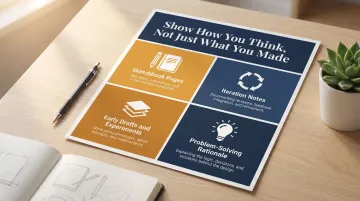
Admissions reviewers don't just want polished final pieces. They want to see how you think, experiment, and recover from dead ends. Include:
- Sketchbook pages showing early concepts
- Iteration notes documenting refinements
- Early drafts and failed experiments
- Problem-solving steps and decision rationale
MIT's Maker Portfolio explicitly states: "We are more interested in your build process than your end results." Process documentation demonstrates intellectual curiosity and genuine creative development—particularly important for undergraduate applications.
Tailored vs. General Portfolio Content
Create a master portfolio containing your strongest work, then customize subsets for each school. Some pieces should be universal "best work," while 2-3 pieces should directly reflect the specific program. For example, if applying to an urban planning program, including architectural sketches or community design work signals that you've researched the program and can see yourself contributing to it.
How to Build Your University Portfolio Step by Step
Building a strong portfolio is not a last-minute task. It requires intentional planning, consistent practice, and time to generate and refine work.
Step 1: Research Your Target Programs
Check exact portfolio requirements for each university and program:
- Number of pieces required
- Acceptable formats (digital, physical, or both)
- Submission platforms (SlideRoom, PebblePad, direct upload)
- Deadlines (often earlier than application deadlines)
Create a checklist tracking each school's requirements separately. RISD requires 12-20 pieces, while Parsons BFA programs ask for 8-12 slides. Missing format requirements signals lack of attention.
Step 2: Generate Portfolio-Worthy Projects
If you don't yet have strong portfolio pieces, build them intentionally—not just as classroom assignments. Participate in hands-on, real-world projects:
- Community design challenges
- Innovation programs with documented outcomes
- Independent builds solving actual problems
- Maker projects documenting problem, process, and outcome
Maker's Asylum's Innovation School, for example, gives students structured frameworks for building exactly this kind of work: documented prototypes, STEAM builds, and interdisciplinary problem-solving projects that translate directly into portfolio-ready material.
Step 3: Select and Curate Your Work
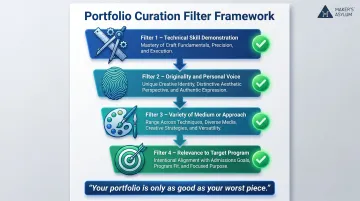
Lay out all candidate pieces and apply a selection filter:
- Technical skill demonstration
- Originality and personal voice
- Variety of medium or approach
- Relevance to target program
Include only completed work or intentional works-in-progress that are part of a documented series. CCA advises: "Your portfolio is only as good as your worst piece. Edit wisely." Avoid classroom assignments that could be submitted by any student in the same class.
Step 4: Document and Photograph Your Work Professionally
Once you've selected your pieces, how you present them matters just as much as what you've made. Poorly photographed work undersells even strong pieces.
Photography guidelines:
- Use good lighting—two light sources at 45-degree angles
- Shoot against clean neutral backgrounds
- Ensure images are sharp and properly cropped
- Photograph 3D work from multiple perspectives
- Prepare short showreels or edited clips for digital/performance work
MassArt recommends: "Crop your images so the artwork is centred and omits background distractions. Use even, white light when photographing your work."
Step 5: Build and Lay Out the Portfolio
Layout best practices:
- Organise work by project to create narrative flow: research, process, then outcome
- Use landscape format pages
- Embrace white space—avoid cluttered layouts
- Use InDesign, Canva, or PowerPoint for digital pages
- Start and end with your strongest pieces
- Keep annotations concise and factual (title, medium, dimensions, date)
Step 6: Seek Feedback and Revise
Get feedback before final submission from:
- Art or STEAM teachers
- Mentors or school counsellors
- National Portfolio Day events where admissions representatives review work in person
When you share your portfolio, ask reviewers three specific questions:
- Does this demonstrate technical skill clearly?
- Is there a consistent personal voice throughout?
- Does the sequence feel logical and organised?
Revise based on their responses, proofread all written components, and test every link before submitting digitally.
What Makes a University Portfolio Stand Out
Two students can follow the same process and produce very different results. The difference lies in critical qualities that admissions readers look for and remember.
Tell a Story Through the Work
The most memorable portfolios don't just display finished pieces: they convey a point of view. Think about the theme running through your work: What do you care about? What does the world look like through your eyes? Parsons states: "Personal and conceptual work is preferred over generic pieces."
Demonstrate Conceptual Thinking and Originality
Admissions reviewers see hundreds of portfolios. Work that demonstrates genuine thinking stands out: an unusual material choice, an unexpected interpretation of a prompt, a design solving a real problem in a new way. A strong concept with developing technique proves more compelling than technically perfect but derivative work.
Show Documented Process, Not Just Outcomes
Universities like UAL, RISD, and others explicitly look for evidence of experimentation, iteration, and learning from failure. Sketchbooks, prototype logs, annotated research pages, and before-and-after iterations demonstrate how a student thinks — the reasoning behind decisions, not just the finished result.
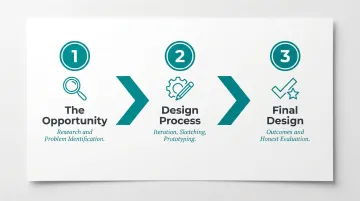
Loughborough's Product Design program recommends a three-part structure per project:
- The Opportunity — research, problem identification
- Design Process — iteration, sketching, prototyping
- Final Design — outcomes and honest evaluation of what worked and what didn't
Tailor Each Submission to the Program
A portfolio that clearly speaks to the values and focus of the specific program signals maturity and genuine interest. For example, a student applying to an environmental design program who includes a project redesigning packaging using recycled materials shows alignment with program values. Research the program's ethos, faculty work, and student projects to identify what they value and reflect that in selected pieces.
Common Mistakes to Avoid When Creating Your Portfolio
Including Too Much or Too Little Work
More pieces doesn't mean a stronger portfolio. One weak piece can undermine many strong ones. Curate ruthlessly and only include work you are genuinely proud of. Avoid submitting half-finished pieces unless they are part of a documented, intentional series.
Ignoring Program-Specific Requirements
Each university has different expectations—some want focus on one medium, others want range; some require observational drawing, others don't. Parsons explicitly discourages "Roblox images, Sims housing renderings, TikTok videos, anime drawings, or images that are direct copies of another artist's work." Failing to research and follow a programme's specific requirements signals a lack of genuine interest — and can disqualify you before reviewers even look at your work.
One more thing that catches applicants off guard: portfolio deadlines often precede general application deadlines. Missing them removes you from consideration regardless of work quality.
Neglecting Presentation Quality and Written Components
Strong work loses impact when the presentation fails. Common culprits include:
- Poor photography or inconsistent image quality across pieces
- Cluttered layouts that make it hard to focus on individual work
- Typos or grammatical errors in your artist statement
- Vague, generic statements that don't reflect your actual thinking
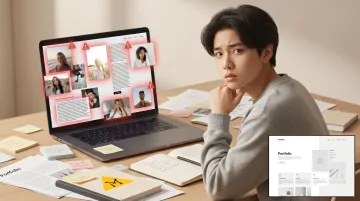
Your artist statement is not a formality — it's where reviewers look for intellectual maturity. A specific, honest reflection on your process and intentions can set your portfolio apart even when the work itself is still developing.
Frequently Asked Questions
What is a portfolio for a uni application?
A university portfolio is a curated collection of your best work submitted alongside your application. Admissions teams use it to evaluate skills, creativity, and potential for programs in arts, design, STEAM, architecture, and other fields where grades alone cannot fully represent abilities.
What should be in a portfolio for college?
Most portfolios include 8–20 work samples (depending on the program), a personal artist or maker statement, and a resume or CV. Process documentation — sketchbook pages, prototype logs, design iterations — is optional but often what distinguishes a strong application.
What are the 7 steps of the portfolio process?
The key stages are:
- Research program requirements
- Generate and create work
- Select and curate pieces
- Document and photograph work professionally
- Build and lay out the portfolio
- Seek feedback and revise
- Submit before the deadline
When should I start building my university portfolio?
Start documenting and saving work from Grade 9 or 10. Begin organising and designing your portfolio 6 to 12 months before application deadlines — strong portfolios take time to build and refine.
Can I include STEAM or maker projects in a university portfolio?
Yes. Project-based STEAM work — prototypes, documented builds, design iterations — is highly relevant for engineering, product design, architecture, and creative programs. The key is showing your process and thinking, not just the finished result.