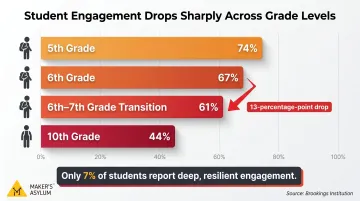
Middle school — roughly ages 11 to 14 — is when this difference matters most. Students at this stage are developmentally ready for independence, real-world connection, and hands-on exploration. Yet most classroom structures still rely heavily on lectures and memorization. The result? Engagement plummets. According to a 2025 Brookings Institution study, 86% of 3rd graders report learning a lot in school, but by 6th grade, that drops to 67%, and by 10th grade, just 44%.
This article explores what experiential learning is, why it matters specifically for middle schoolers, and which hands-on activities actually work — whether you're a teacher planning a unit, a parent supporting learning at home, or an educator looking to bring your curriculum to life.
Key Takeaways
- Experiential learning means learning through direct experience, reflection, and real-world application — not passive instruction
- Middle schoolers learn better this way: ages 11–14 mark the shift from concrete to abstract thinking
- Project-based learning boosts achievement by 11–18 percentage points across subjects
- Best activities include maker challenges, simulations, structured field trips, hands-on science, and student-led passion projects
- Maker's Asylum's Innovation School pairs online STEAM learning with hands-on maker residencies in Goa for students 13+
What Is Experiential Learning and Why Does It Matter for Middle Schoolers?
Experiential learning is learning through direct experience and reflection. Psychologist David Kolb defined it in 1984 as a four-phase cycle:
- Concrete Experience — the learner encounters a hands-on experience
- Reflective Observation — they reflect on the experience in light of what they already know
- Abstract Conceptualization — reflection leads to a new idea or modified understanding
- Active Experimentation — they test the new concept in a real-world setting
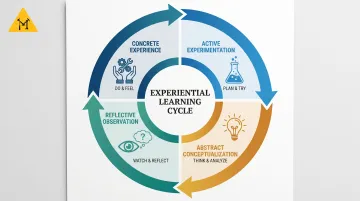
In a middle school classroom, this might look like: building a water filtration system (experience), discussing why certain materials worked better than others (reflection), forming a hypothesis about filtration principles (conceptualization), and testing a redesigned version (experimentation).
Why this matters for ages 11-14 specifically:
Middle schoolers are in what developmental psychologists call the "formal operational stage." According to Stanford Medicine Children's Health, adolescents at this stage develop the ability to "do abstract thinking," "think about possibilities," and "reason from known principles." But research also shows that relational reasoning actually dips during ages 11-14, before recovering in late adolescence.
This means students are building abstract reasoning capacity but still need concrete, hands-on scaffolding to bridge the gap.
Passive instruction often loses them. Consider the data:
- A Gallup poll of 909,617 students found that 74% of 5th graders are engaged with school, but engagement drops 13 percentage points between 6th and 7th grade — the steepest decline in K-12
- Only 7% of students report school experiences conducive to deep, resilient engagement
- Engaged students are 2.5 times more likely to report excellent grades; disengaged students are 9 times more likely to report poor grades
What separates experiential learning from just "doing activities" is intentional reflection and application. A student who builds a bridge from popsicle sticks without discussing why it held weight or failed is completing a task. A student who tests the bridge, writes down observations, discusses structural engineering principles with peers, and redesigns it based on feedback is doing something fundamentally different.
That distinction has real stakes. Universities and employers now actively look for communication, teamwork, critical thinking, and persistence — the exact competencies developed through hands-on, real-world problem-solving.
Top Experiential Learning Activities for Middle School Students
These activities span different subjects and settings, but the core principle is the same: students learn by doing.
Project-Based Learning (PBL)
What it is: PBL is an approach where students tackle a real-world question or challenge over an extended period and produce a tangible output.
Middle school examples:
- Designing a solution to reduce waste in the school cafeteria — students audit waste, research composting and recycling systems, create a proposal, and present it to administrators
- Investigating a local environmental issue (water quality, air pollution, deforestation) and producing a multimedia presentation for community stakeholders
Why it works for this age group:
Research from Lucas Education shows that middle school students using project-based science curricula outperformed peers by:
- 11 percentage points on science assessments
- 12-18 percentage points on mathematics assessments
- 8-10 percentage points on English Language Arts assessments
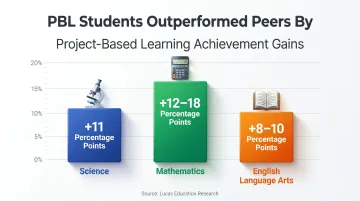
PBL gives students agency and purpose. Instead of memorizing isolated facts, they research, collaborate, present, and iterate — skills that map directly to academic success and real-world problem-solving.
Maker and Build Challenges
What it is: Maker-based challenges ask students to design and build something using tools, materials, and their own creativity. The result is a working prototype, a functional model, or a piece of engineering art.
Examples:
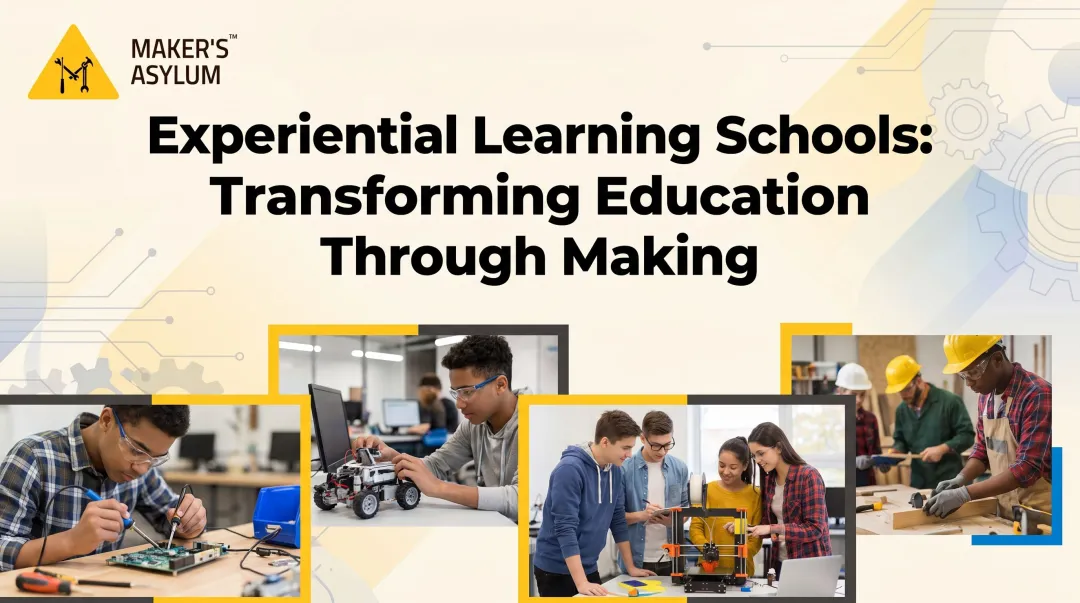
- Building a simple circuit to power an LED light
- Constructing a bridge from recycled materials and testing its load capacity
- Programming a basic robot to navigate a maze
Why it works:
These challenges embrace the "make, break, iterate" mindset. Students encounter real failure, troubleshoot it, and rebuild — practicing the kind of iterative problem-solving that formal instruction rarely teaches. This is the pedagogy behind programs like Maker's Asylum's Innovation School, where students in grades 7+ build air quality monitors, IoT lamps, and robotics vehicles alongside experienced maker mentors.
The evidence for maker education is growing: a systematic review of 22 studies found that makerspace activities complement academic goals and that most research focuses on middle and high school students, confirming the approach is well-matched to this developmental stage.
Role-Playing and Simulations
What it is: Simulations are immersive scenarios where students take on roles — conducting a mock trial, participating in a Model UN session, re-enacting a historical event, or pitching a business idea.
Examples:
- Mock trial: students argue a real legal case, researching evidence and cross-examining witnesses
- Model UN: students represent countries, draft resolutions, and negotiate with peers
- Business pitch simulation: teams develop a product idea and present to a panel of "investors"
Why they're powerful for middle schoolers:
Simulations build empathy, sharpen decision-making, and make abstract subjects feel alive. A 2024 study of 539 secondary students (mean age 14.29) found that participants in an empathy-based program showed significantly higher empathy levels, which in turn predicted greater prosocial behaviour and social responsibility.
Research from the University of Virginia found that social awareness drops around sixth grade and doesn't recover until ninth grade. Structured simulations can counteract this dip by giving students practice in perspective-taking and collaborative problem-solving.
Field Trips and Community Immersion
What it is: Field trips become experiential learning when tied directly to classroom content before and after the visit.
Effective examples:
- Visiting a local farm to study food systems, then mapping the supply chain in class
- Touring a small business to learn about entrepreneurship and creating a business plan afterward
- Spending time in a nature reserve to observe ecology in action, followed by data analysis
Key design principle: A landmark study of 10,912 students visiting Crystal Bridges Museum found that structured field trips produced gains of 9% of a standard deviation in critical thinking overall, rising to nearly one-third of a standard deviation for rural students. Benefits were largest for students from less-advantaged backgrounds.
The difference came down to structure. Students were given a specific task during the visit — observe, interview, document — and a reflection component afterward. That pre-and-post scaffolding is what converts an outing into genuine learning.
Science and Engineering Experiments
What it is: Students form a hypothesis, conduct a hands-on experiment, and analyze results — applying the scientific method to something tangible.
Examples:
- Testing chemical reactions by cooking and analyzing ingredients
- Designing and testing a water filtration system
- Measuring forces using self-built contraptions (catapults, ramps, pulleys)
Why experiments work in middle school:
A meta-analysis by Caglak (2017) found hands-on science activities produced a Hedge's g of 1.55 — a very large effect size on science achievement. Another large-scale study published in PNAS analyzed 225 studies and found active learning increased exam scores by approximately 6%, while traditional lecturing increased failure rates by 55%.
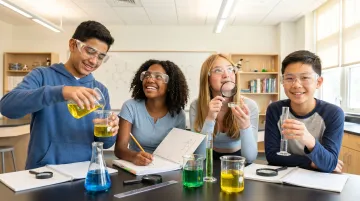
Experiments satisfy natural curiosity while anchoring abstract science concepts in observable, physical reality.
Passion Projects and Student-Led Research
What it is: Students choose their own topic — something they genuinely care about — and explore it deeply through research, creation, or community engagement. The deliverable can be a presentation, a prototype, a written piece, or an event.
Why this matters:
Passion projects develop intrinsic motivation and self-direction. Research shows that service learning and self-directed projects in middle school lead to improved social responsibility and greater academic success, with the strongest gains among students deemed most at-risk for academic and behavioural issues.
For students who struggle with traditional schoolwork, a passion project can be the first time school feels personally meaningful — and that shift in engagement tends to carry forward.
How to Bring Experiential Learning Into the Classroom or at Home
You don't need a lab or a makerspace to begin. Start small: replace one worksheet-based task per week with a hands-on alternative. The key ingredients are a real problem, student agency, and structured reflection at the end.
Three implementation principles:
- Anchor activities to the curriculum — ensure they reinforce academic goals rather than feeling like "extra" work
- Build in debrief time — students should articulate what they learned and how; reflection is what turns an activity into experiential learning
- Allow iteration — the willingness to try again after failure is itself the lesson
These principles apply beyond the classroom too. Parents can create the same conditions at home without special equipment.
For parents supporting learning at home:
- Build something together from scratch — even a simple structure or repair project counts
- Cook a meal while exploring the chemistry behind what's happening (why does bread rise? why does oil repel water?)
- Visit a local organization, market, or community space and debrief what you observed together
The setup doesn't need to be elaborate — what matters is that students engage with a real problem, make decisions, and reflect on what they found.
Beyond the Classroom: Programs and Spaces That Make It Real
For deeper, more sustained experiential learning, dedicated programs and spaces offer what a standard classroom often cannot: real tools, mentors with domain expertise, peer communities, and structured room to experiment, fail, and rebuild — without the pressure of grades.
One example is Maker's Asylum's Innovation School, designed for students from grades 7 onward. The program combines 50 hours of online skill-building with a 7-day intensive residency in Goa, India, where students work on hands-on STEAM projects — building air quality monitors, programming IoT lamps, and creating robotics prototypes.
Students gain access to:
- Electronics, fabrication tools, laser cutters, and 3D printers
- Mentorship from experienced makers and engineers
- A global community spanning 50+ cities and 40+ countries
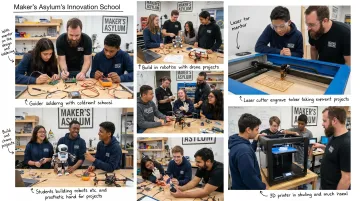
The portfolios they build hold weight with universities globally — alumni have gone on to MIT, Stanford, Cambridge, IIT, and other top institutions.
This model reflects a larger trend: India has established 10,000 Atal Tinkering Labs engaging over 11 million students, with 50,000 additional labs planned. Government-backed maker education is scaling rapidly as a national priority.
What to look for in experiential programs:
- Structured learning outcomes combined with creative freedom
- Mentorship from domain experts, not just facilitators
- Opportunities to build portfolios that demonstrate real competency
- Emphasis on collaboration, iteration, and problem-solving
Programs that check all four boxes tend to produce students who don't just know how to use tools — they know how to define a problem and work through it independently.
Conclusion
The middle school years are too important to spend entirely in passive learning mode. When students build, simulate, investigate, and reflect, they retain information and build the habits of mind that serve them for life.
Start wherever you are: one project, one field experience, one maker challenge. That's enough to get moving.
If you're looking for a structured, mentor-led experiential learning environment for a middle schooler, explore what Maker's Asylum's Innovation School offers — a program where hands-on making is the core of the curriculum, not an add-on to it.
Frequently Asked Questions
What is experiential learning and give an example?
Experiential learning is learning through direct experience and reflection, following Kolb's cycle of concrete experience, reflection, conceptualization, and experimentation. For example, a middle school student builds a working water filtration system, tests which materials work best, discusses why certain filters performed better, and redesigns the system based on findings.
What are examples of experiential learning activities?
Common examples include:
- Project-based learning (solving real-world problems over weeks)
- Maker challenges (building prototypes with hands-on tools and materials)
- Simulations and role-play (mock trials, Model UN)
- Field trips with structured reflection tasks
- Student-led passion projects on self-chosen topics
What are the four types of experiential learning?
Kolb's model defines four phases, not types: Concrete Experience (doing something hands-on), Reflective Observation (thinking about what happened), Abstract Conceptualization (drawing new conclusions), and Active Experimentation (testing those conclusions in practice). Learners cycle through these phases repeatedly.
How to implement experiential learning in school?
Start by replacing one passive task per week with a hands-on alternative. Tie the activity to curriculum goals so it reinforces academic standards. Always include a structured reflection or debrief afterward where students articulate what they learned and how — without reflection, it's just an activity, not experiential learning.
What are experiential learning programs?
Experiential learning programs deliver education through real-world projects, mentorship, and hands-on making rather than traditional instruction. Examples include makerspace courses, service-learning programs, STEAM residencies, and innovation schools like Maker's Asylum's program for teens 13+.
What are some fun middle school activities?
Engaging options include escape room-style engineering challenges, maker projects (circuits, robots, 3D-printed designs), hands-on science experiments, mock trials, and passion project showcases. The best activities pair genuine fun with skill-building and structured reflection.