Introduction
Traditional education teaches students about the world's problems—climate change, inequality, healthcare access—but seldom teaches them how to act on them. Graduates can name every Sustainable Development Goal but struggle to build a single solution. Social innovation education changes this by shifting students from passive knowledge consumers to active changemakers equipped with skills, confidence, and agency.
Social innovation education is a cross-disciplinary learning approach that prepares students to identify, understand, and create solutions to social, environmental, and economic challenges—through hands-on experimentation, systems thinking, and real-world collaboration, not just classroom theory.
The need is urgent. Only 17% of SDG targets are on track, and the problems students face today demand a new kind of thinker that conventional education rarely develops.
Here's what that looks like in practice—the skills it builds, how it works, why it matters now, and what students can actually create.
TLDR:
- Social innovation education equips students to solve real-world challenges, not just study them
- Builds empathy, systems thinking, collaboration, agency, and design thinking skills
- Combines hands-on making, design thinking, and community engagement
- Indian students have real potential to lead global social innovation—with the right education behind them
- Top universities worldwide actively seek students with maker portfolios and hands-on project experience
What Is Social Innovation Education?
Social innovation education prepares students to identify, understand, and create solutions to complex social, environmental, and economic challenges across disciplines—not within a single subject area. The OECD defines social innovation as "creating and implementing new solutions that entail conceptual, process, product, or organisational changes, with the ultimate goal of enhancing the welfare and well-being of individuals and communities." Social innovation education translates this definition into a learning model centred on action, not consumption.
This approach goes beyond classroom theory. Students engage in empathy-building, systems thinking, collaborative problem-solving, and real-world experimentation—often working directly with the communities they're trying to help. The difference from conventional education shows up in concrete ways:
- Instead of learning chemistry to pass exams, students apply it to design low-cost water filtration systems
- Rather than studying poverty as a statistic, they interview migrant workers to understand real barriers to dignity and safety
Social innovation education is distinct from conventional STEM or business education because it starts with purpose and community impact, not career outcomes or profit. The driving question isn't "What career does this lead to?" but "What problem can I help solve?" According to the OECD, social innovation education is still in its early stages globally—most school systems lack formal curricula for it, and few institutions have moved beyond pilot programmes.
How It Differs From Social Entrepreneurship
Social innovation education and social entrepreneurship are related but distinct. Social entrepreneurship focuses on funding models and business structures for social change—scaling ventures, achieving financial sustainability, and attracting investment. Social innovation education is a broader approach to learning and thinking that anyone can engage with, regardless of whether they plan to start a business.
You don't need to be an entrepreneur to be a social innovator. This approach applies across every discipline:
- Artists designing accessible learning tools for students with disabilities
- Engineers building renewable energy prototypes for off-grid communities
- Any student learning to see a problem as a system worth changing
Why Social Innovation Education Matters More Than Ever
The challenges students will inherit — climate change, inequality, healthcare access, food security — are systemic, cross-disciplinary, and accelerating. The 2024 UN SDG Report reveals that only 17% of SDG targets are on track; the rest are stalled or regressing.
In 2023, 733 million people faced hunger. If current trends hold, 590 million will still live in extreme poverty by 2030. These numbers demand people with the skills and drive to build solutions, not just study them.
At the same time, the skills gap is widening. The World Economic Forum's 2023 Future of Jobs Report warns that 44% of workers' core skills will be disrupted by 2027, with 60% requiring training before that deadline. Employers cite analytical thinking and creative thinking as top skills through 2027—exactly the capabilities social innovation education builds.
India's Opportunity
India's context makes social innovation education especially urgent. The demographic and environmental pressures are converging fast:
- 65% of the population is under 35 — a massive pool of potential innovators
- Urban population will cross 40% by 2030, creating new demands on infrastructure and services
- India ranks 59th most climate-vulnerable globally, with healthcare, education access, and resilience challenges compounding the pressure
Indian students are positioned to be among the most impactful social innovators in the world.
That potential runs up against a stark reality. Learning poverty in India stands at 56% — more than half of late-primary-age children cannot read or understand a simple text by age 10. Social innovation education offers a direct pathway to bridge this gap, equipping students with practical skills and the confidence to act.
Key Skills Students Build Through Social Innovation Education
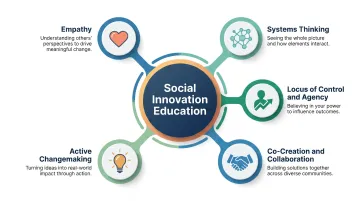
Social innovation education builds five interconnected capacities that fundamentally change how students see themselves and the world.
Empathy as Foundation
Students learn to understand problems from the lived experience of those affected — conducting empathy interviews with communities, observing challenges firsthand, and shifting between personal, community, and systemic perspectives.
This goes well beyond classroom reading. A student designing assistive technology works directly with differently abled peers to co-create solutions, not just study the problem from a distance.
Systems Thinking
Research documents that K-12 classrooms have taught systems thinking for up to two decades using tools like causal loop diagrams and system dynamics models. Students learn to see problems as interconnected systems, not isolated incidents — recognizing how one decision, say, plastic packaging, creates ripple effects across pollution levels, marine ecosystems, and waste management costs. Traditional subject-based schooling almost never develops this skill, yet it's essential for tackling challenges like climate change or public health.
Locus of Control and Agency
Social innovation education shifts students from passive observers to active participants who believe their actions matter. A 2024 literature review synthesizes evidence that student agency relates to autonomy, self-efficacy, and motivation, and can be supported by project-based learning. Students stop waiting for adults to fix the world and start asking: What can I do?
Co-Creation and Collaboration
Students work across disciplinary, cultural, and social boundaries — not as tokenistic group work, but as genuine shared problem-solving. A 2023 meta-analysis of project-based learning found positive effects on academic achievement (SMD ~0.650), creative thinking (~0.626), and learning interest (~0.713), with optimal small-group sizes of 4-5 enhancing impact (~0.909).
From Passive Learners to Active Changemakers
Together, empathy, systems awareness, agency, and co-creation produce graduates who are genuinely prepared to act — not just academically accomplished. Top universities worldwide now seek exactly these qualities, and portfolios of real-world impact carry real weight alongside grades. Maker's Asylum alumni have earned places at MIT, Imperial College London, Columbia, Berkeley, and other leading institutions on the strength of what they've built and solved.
How Social Innovation Education Works in Practice
Design Thinking and Systems Thinking as Core Tools
Design thinking provides the practical methodology: students define a problem, research the people affected, brainstorm solutions, prototype, and test—a cycle that keeps human impact at the centre. Stanford's d.school and IDEO U have popularized this approach globally, with educators adapting it for K-12 contexts.
Systems thinking serves as the complementary lens. Once students understand who is affected, systems thinking helps them understand why the problem persists and where interventions create lasting change. RISE Programme research shows how systems thinking frameworks can help diagnose problems and identify leverage points in complex environments.
Learning by Making—The Hands-On Approach
Social innovation education works best when it's hands-on, project-based, and anchored in real problems. A Harvard-led study found students learned more with active learning than polished lectures, even though they felt they learned less. When students physically prototype a solution, test it with real users, and iterate based on feedback, they experience the full innovation cycle in a way textbooks cannot replicate.
Maker's Asylum's SDG School and Innovation School exemplify this model. Students aged 13 and above work on purpose-driven projects addressing real-world challenges, supported by mentors, tools, and a global maker community. The scale of impact speaks for itself:
- Innovation School: 400+ students across 50+ cities and 40+ countries, building portfolios that reflect genuine outcomes
- SDG School: 2,000+ alumni who have completed 300+ social innovation projects across 40+ nations
Cohort-based learning—where students learn alongside equally committed peers—accelerates growth. Teams prototype together, troubleshoot collectively, and celebrate shared wins. Alumni regularly credit the cohort experience with shaping not just their technical skills, but their confidence to take on real-world problems.
This hands-on model has also scaled at the policy level. In India, government initiatives like Atal Tinkering Labs have established 10,000+ school-based makerspaces across 722 districts. Assessment data from these labs shows:
- 75% of schools reported more positive student attitudes toward science and technology
- 69% reported more students pursuing science in higher studies
- 58% reported measurable improvement in 21st-century skills
What Innovations Can Students Create in School?
Students can pursue tangible innovations addressing real community challenges, starting with problems they observe directly:
Environmental and Sustainability Solutions:
- Low-cost water filtration systems using locally available materials
- Community composting programmes reducing organic waste
- Medicine waste upcycling (like the PRESET project, converting pharmaceutical blister packs into lifestyle products and animal shelter roofing)
- Renewable energy prototypes with solar tracking and energy monitoring
Education and Access:
- Accessible learning tools for differently abled peers
- Apps mapping local resources (libraries, tutoring centres, health clinics)
- Educational content translated into regional languages
Health and Safety:
- Emergency response tools for natural disasters
- Products improving dignity and safety for migrant workers or vulnerable communities
- Water consumption monitoring systems for schools and hostels
Marine and Environmental Protection:
- Underwater ROVs for ghost net retrieval from oceans
- River cleanup devices using low-cost materials and remote control
The most effective school-based innovations start local — a broken streetlight, a polluted river, a gap in health services — and grow outward from there. These examples show the range of what's possible. What they share is a structured process for getting from problem to prototype.
The Student-Led Innovation Process
A structured school-based innovation process typically follows these steps:
- Observe and identify a specific community problem through direct engagement
- Interview affected people to understand their experience, not just the surface issue
- Reframe the challenge using what you've learned — often the real problem differs from the obvious one
- Brainstorm solutions with a diverse group, prioritising breadth before narrowing down
- Build a rough version fast — cardboard, tape, and basic electronics count
- Put it in front of real users and watch how they interact with it
- Revise based on what you observe, not just what users say
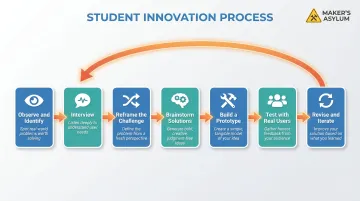
In practice, this process loops back on itself. A prototype test often sends students back to step two. That's by design — each cycle sharpens both the solution and the student's ability to sit with uncertainty and keep going.
Frequently Asked Questions
What is social innovation education?
Social innovation education is a cross-disciplinary learning approach that equips students with the skills, mindsets, and tools to tackle complex social, environmental, and economic challenges. It combines hands-on experimentation, systems thinking, and real-world collaboration—inside the classroom and beyond it.
What innovations can be done in a school?
School-based innovations include accessible assistive tools for differently abled students, community health or environmental projects (composting, water conservation), resource-sharing platforms, low-cost prototypes addressing local needs (water filters, energy monitors), and emergency response tools. Innovation starts with real problems students observe in their communities.
What are the 7 steps of innovation?
The innovation process typically covers: problem identification, research and empathy building, idea generation, concept development, prototyping, testing and feedback, and iteration/scaling. In social innovation, the process is iterative rather than strictly linear—students move back and forth between phases based on what they learn.
How does hands-on learning support social innovation?
Hands-on, project-based learning allows students to move through the full innovation cycle—from problem framing to physical prototyping and real-world testing with communities. This builds both technical skills and confidence that theory-based learning alone cannot replicate, creating changemakers who know they can act.
What skills do students develop through social innovation education?
Through social innovation education, students build:
- Empathy — understanding the lived experiences of those they're designing for
- Systems thinking — identifying interconnected causes, not just surface symptoms
- Collaborative problem-solving and design thinking
- Agency — the belief that their actions can create real change
How can a student get started with social innovation?
Start by observing your immediate community — what challenges do people face daily, and why do they persist? Then find a hands-on learning environment — a makerspace, innovation program, or project-based school — where you can prototype and test ideas with real mentorship and tools.
Social innovation education equips students to act on the problems they see around them — not after graduation, but now. When empathy, technical skills, and real-world context come together in a learning environment, students stop waiting for solutions and start building them.