: A Student Guide](https://file-host.link/website/makersasylum-w7ezfv/assets/blog-images/810f7404-2a7b-411e-82e1-92655b981916/1778001423382494_88c288986d8f4be7a61df93adb0041e0/360.webp)
Introduction
Most ideas meant to help people don't fail because the problem wasn't real. They fail because the solution was built around assumptions instead of people.
Design thinking for social innovation is a structured, people-first problem-solving method that starts with the humans affected by a challenge — not your best guess at a fix. Whether you're tackling education gaps, clean water access, or mental health support, guesswork and good intentions alone won't get you there.
This guide walks you through what design thinking is, why it's uniquely powerful for addressing social problems, how to use its five stages (Empathize, Define, Ideate, Prototype, Test), and how to start applying it.
Key Takeaways
- Design thinking is a five-stage iterative process that moves from understanding real people to testing real solutions
- It centers real people—not your assumptions—in every stage of solution development
- Iteration is built into the process — refining and failing forward is how better ideas emerge
- Students worldwide apply it to healthcare access, education, sustainability, and community wellbeing
- The strongest outcomes come from human insight gathered in the field, not assumptions made at a desk
What Is Design Thinking for Social Innovation?
Design thinking is a human-centered, iterative methodology that moves from understanding people's lived experiences to creating, testing, and refining solutions. It originated at IDEO in 1991 and was later popularized by Stanford's d.school — built on the premise that empathy and rapid prototyping produce better solutions than abstract planning alone.
Social innovation refers to new approaches — products, services, programs, or models — that meet social needs more effectively than existing solutions. According to Stanford Social Innovation Review, social innovation differs from charity or corporate social responsibility because value flows primarily to society, not private stakeholders, and solutions must sustain themselves rather than depend on ongoing subsidies.
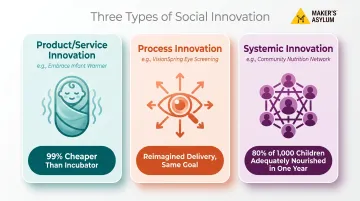
As a student, you'll likely encounter three distinct types of social innovation in practice:
- Product/Service Innovation — The Embrace Infant Warmer, built by Stanford students, costs 99% less than a standard incubator and has saved thousands of newborn lives in low-resource settings. This is what it looks like when a new tool fills a gap no existing product could.
- Process Innovation — VisionSpring in India reimagined child eye screenings as playful experiences instead of intimidating medical exams, reaching 3,000 children by September 2009. Same goal, radically different delivery.
- Systemic Innovation — In Vietnam, researchers identified local families whose children thrived despite poverty, then spread those practices community-wide. Within one year, 80% of 1,000 enrolled children were adequately nourished — in a region where 65% of children had been malnourished. No new product, no new service: just a model change.
Why Social Problems Need Design Thinking
Social challenges aren't like technical problems. They're what design theorists Horst Rittel and Melvin Webber called "wicked problems." These challenges have no definitive formulation, no true-or-false solutions, and every attempt to solve them counts. According to their 1973 framework, the way you describe a wicked problem determines its possible solutions, making perspective and empathy critical—which is exactly where design thinking comes in.
What typically goes wrong without design thinking:
Top-down solutions built on assumptions frequently fail. The Independent Evaluation Group rated 39% of World Bank projects as unsuccessful in 2010. When students or organisations skip empathy research, they jump to solutions that communities don't want or can't use.
Consider the Naandi Foundation water plant in India. Engineers built a technically sound purification system — but 5-gallon containers were too heavy for women to carry on their heads, the primary local transport method. The monthly punch-card forced families to buy more water than they needed.
The technology functioned. The design never accounted for the people using it.
Why design thinking directly addresses this gap:
- Empathy forces you to listen before you build, grounding solutions in real context
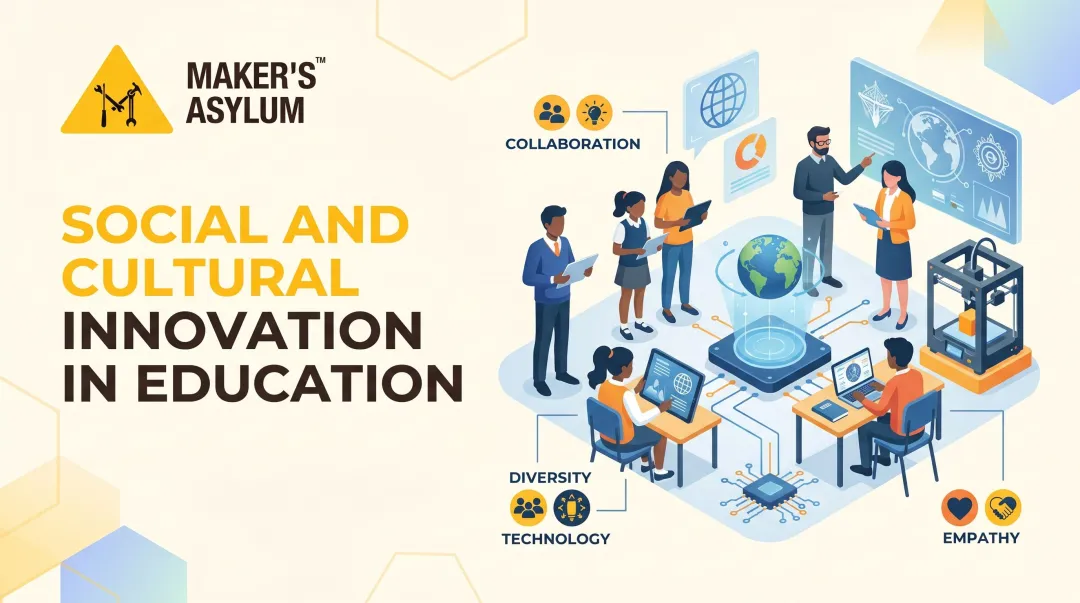
- Collaboration surfaces perspectives that solo thinking consistently misses
- Prototyping reduces large-scale failure by testing ideas early and cheaply — so you pivot on real feedback, not assumptions
The 5 Stages of Design Thinking for Social Innovation
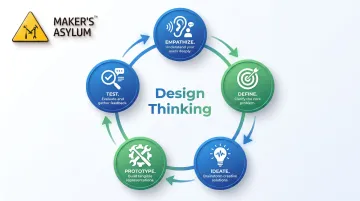
The Stanford d.school's five-stage model is a loop, not a linear checklist. You will move back and forth between stages based on what you learn—this iterative nature is what makes the process powerful for complex social challenges.
Stage 1: Empathize
Empathizing means spending time with people directly affected by the problem: observing, interviewing, and listening without judgment or pre-formed solutions. This is a different approach from surveys or internet research, which give you data but not human stories.
Your starting activity:
Conduct at least three in-person conversations with people experiencing the challenge. Use open-ended, story-based questions:
- "Tell me about a time when..."
- "What was your best/worst experience with..."
- "Walk me through how you..."
Avoid leading questions like "Would it help if..." or "Don't you think that..." These suggest solutions and shut down authentic stories.
Stage 2: Define
Defining means synthesizing everything learned during empathy into a clear, human-centered problem statement—often framed as a "How Might We" question. This step is frequently skipped, which leads to solving the wrong problem entirely.
Weak problem statement: "People need cheaper food."
Strong problem statement: "Families in low-income neighborhoods need convenient access to culturally relevant nutritious food and practical cooking guidance."
The strong version specifies who, what context, and what's truly needed—not just a generic category.
Stage 3: Ideate
Ideation is structured brainstorming where quantity matters more than quality. The goal is to generate many ideas, including wild ones, before filtering. Research shows that teams alternating between individual and group ideation outperform solo-only or group-only approaches.
Techniques to push past obvious solutions:
- Brainwriting (everyone writes ideas silently before sharing)
- "Yes, and" thinking (build on others' ideas instead of critiquing)
- Worst possible idea (generates laughter and loosens rigid thinking)
Working in diverse groups, including community members, consistently produces better ideas than working alone. Maker's Asylum's SDG School is built on this principle, bringing together students from different backgrounds across 40+ countries to tackle UN Sustainable Development Goals through collaborative ideation.
Stage 4: Prototype
A prototype is not a finished product. It's the cheapest, fastest representation of an idea that you can put in front of real people. For students, this might be:
- Paper mock-ups
- Cardboard models
- Role-plays
- One-page service blueprints
Prototyping is about building to learn, not building to impress. Maker's Asylum's core value of "Make, Break, Create" captures this directly: build imperfect things, test them, and iterate without attachment.
Stage 5: Test
Testing means putting your prototype in front of actual users (not teachers or parents) and observing how they interact with it, what confuses them, and what works. Listen carefully without defensiveness.
The outcome of testing is almost always iteration, not completion. If testing reveals the problem was mis-defined, return to Define. If users interact with your prototype in unexpected ways, return to Ideate with new insights.
A productive feedback loop looks like: test → observe → ask "why did that happen?" → adjust prototype → test again.
That loop is the process. Each stage feeds the next, and going backward is not failure—it's the point. The deeper you move through these stages, the more clearly the real problem, and the right solution, will come into focus.
Where Students Can Apply Design Thinking
The most accessible social innovation domains for student-aged designers include:
Education and learning access — gaps in school systems, barriers to skills development, digital divide issues
Mental health and peer support — stigma reduction, access to counselling, loneliness and connection challenges
Local environmental challenges — waste management, water quality, energy access in your community
Community health — sanitation, nutrition, hygiene education, access to preventive care
UNICEF's UPSHIFT program shows what students can accomplish: serving young people aged 10-24 across multiple countries, **50% of participants launch income-generating social enterprises**, and participants are 35% more likely to transition into employability pathways.
These outcomes don't come from trying to solve everything at once. You don't need to fix global hunger — starting with a hyper-local problem (a broken system in your school, a gap in your neighbourhood) is more effective and more learnable. Small-scale prototypes can be scaled or replicated later. Trying to tackle everything at once leads to shallow, ineffective solutions.
Maker's Asylum's face shield initiative during COVID-19 is a clear example: 1 million+ shields delivered in 49 days using a centralised open-source design and decentralised community manufacturing — starting from a small maker community responding to a local crisis.
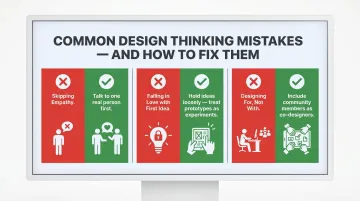
Common Mistakes Students Make — and How to Avoid Them
Mistake 1: Skipping Empathy
Many students jump straight to ideation because it feels more exciting. Solutions built on assumptions almost always miss what the community actually needs.
The fix: Commit to at least one real conversation with an affected person before generating ideas. Even informal chats reveal insights no amount of desk research can provide.
Mistake 2: Falling in Love with Your First Idea
Students often prototype the first idea they come up with and become emotionally attached to it, making it hard to pivot when testing reveals problems.
Instead, hold ideas loosely and treat every prototype as an experiment, not a final answer. When your first idea doesn't work, that's useful data — it's pointing you toward something better.
Mistake 3: Designing for the Community, Not With Them
There's a real difference between designing something for a group of people and co-designing it with them. IDEO.org describes co-design as merging "lived expertise" with "learned expertise"—community members are equal stakeholders, not subjects.
To fix this, invite community members into your ideation and testing stages — not just as feedback-givers, but as active contributors. Solutions shaped this way are more likely to fit, and far more likely to actually stick once your project ends.
Frequently Asked Questions
How is design thinking used in social innovation?
Design thinking is applied to social innovation by using its five stages—especially empathy and prototyping—to understand root causes of social challenges and test human-centered solutions with affected communities before scaling them. This reduces the risk of costly failures and ensures solutions match real needs.
What are the stages of design thinking?
The five stages are Empathize, Define, Ideate, Prototype, and Test. They are iterative, not linear—real projects often loop back between stages multiple times as new insights emerge.
What is design thinking for social innovation?
The key distinction is co-designing with affected communities rather than for them. This means solutions to challenges like equity, access, and community wellbeing are built from lived experience—not assumptions—making them far more likely to work in practice.
What are the types of social innovation?
The main types are product/service innovation (new tools meeting unmet needs), process innovation (better ways of delivering social value), and systemic innovation (new models or policies shifting how whole sectors operate).
What is the personality profile of a design thinker?
Key traits include deep curiosity about people, comfort with ambiguity, willingness to fail and iterate, collaborative instinct, and the ability to shift between creative and analytical thinking. These are learnable habits, not fixed personality traits—anyone can develop them through practice.