Unlike rote memorization, critical thinking prepares students for the unpredictable. It enables them to navigate misinformation, make sound decisions, and adapt to careers that don't yet exist. This article breaks down what critical thinking actually looks like in students, the specific strategies educators and parents can use to build it, the conditions it requires, and the mistakes that silently get in the way.
Key Takeaways
- Critical thinking is learnable through consistent practice, not one-off exercises
- Key strategies: open-ended questioning, real-world problem solving, structured debate, and source evaluation
- Students need psychological safety to question, guess, and be wrong
- Embed critical thinking across all subjects — not just in dedicated lessons
What Critical Thinking in Students Actually Looks Like
Critical thinking is not about being argumentative or overly analytical. It is the ability to ask better questions, weigh evidence, identify assumptions, and arrive at reasoned conclusions. The APA Delphi consensus defines it as "purposeful, self-regulatory judgment which results in interpretation, analysis, evaluation, and inference, as well as explanation."
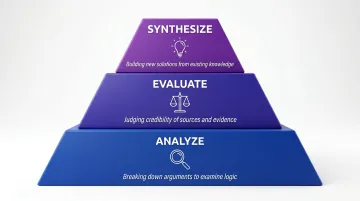
This distinction matters because many classroom activities stop at recall or comprehension—the lower rungs of Bloom's Taxonomy. Critical thinking operates at the higher levels: analysis, evaluation, and creation. At these levels, students are doing three distinct things:
- Analyze — breaking down arguments to examine their components and logic
- Evaluate — judging the credibility of sources and the strength of evidence
- Synthesize — building new solutions or perspectives from existing knowledge
Observable signs that a student is developing critical thinking include:
- Asking probing follow-up questions rather than accepting surface-level answers
- Connecting new information to prior knowledge across subjects
- Identifying inconsistencies in arguments or sources
- Changing their position when presented with new evidence
Students today face an overwhelming flood of information—much of it AI-generated or algorithmically amplified. Research from Stanford found that over 96% of high school students failed to consider industry ties when judging a climate website, and more than half misjudged a misleading video as strong evidence.
The workforce picture is equally urgent. The World Economic Forum ranks analytical thinking as the top core skill demanded in 2023, with 44% of workers' core skills expected to change by 2027.
The question isn't whether critical thinking matters — it's how schools and programs can actually teach it in a way that sticks.
How to Develop Critical Thinking Skills in Students: Core Strategies
No single activity builds critical thinking. It requires a combination of approaches applied consistently across different subjects and settings.
Build a Questioning Culture
Replace knowledge-checking questions ("What is the answer?") with reasoning-checking questions ("Why do you think that?" or "What evidence supports that?"). This small shift moves students from recall to analysis.
The Socratic questioning method structures this approach: teachers ask layered questions to help students examine assumptions and follow their own logic to a deeper conclusion. A 9-week intervention in Turkish 6th-grade classes using Socratic questioning yielded significant gains in critical thinking, critical reading, and creative thinking compared to traditional instruction. This method works in any subject, not just humanities—asking "Why does this formula work?" in math or "What assumptions underlie this experiment?" in science prompts the same analytical thinking.
Assign Real-World Problems to Solve
Authentic, open-ended problems are more effective than textbook exercises because they introduce real constraints, multiple valid solutions, and personal stakes—all of which force genuine reasoning.
This is the foundation of project-based learning (PBL). Meta-analysis of 66 studies found that PBL showed an overall positive effect, with the largest impact at the high school level. Students investigate a real question or challenge over time, gather evidence, and build a reasoned response or product.
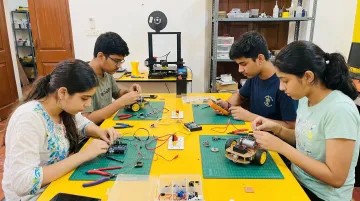
Maker's Asylum's Innovation School puts this into practice directly: students prototype solutions to real problems—sewage worker safety, accessibility challenges, environmental monitoring—and develop critical thinking through hands-on experimentation and iteration rather than through instruction alone.
Teach Information Literacy Explicitly
Students must learn to identify reliable sources, detect bias, distinguish fact from interpretation, and ask "Who is saying this and what do they gain?" That skill is harder to build now that AI-generated content and algorithm-driven feeds make misleading information difficult to spot.
Classroom activity: Have students compare two sources covering the same topic with different perspectives. Ask them to analyse what each includes, excludes, and why. This trains the habit of questioning credibility rather than passively consuming information.
Make Space for Debate and Structured Discussion
Structured class discussions and formal debates force students to:
- Build arguments backed by evidence, not just opinion
- Anticipate counterarguments and prepare reasoned responses
- Listen actively to opposing views rather than waiting for a turn to speak
Research on Academically Productive Talk in middle school science found links between question quality and students' use of higher-order thinking in discussions and assessments.
Teachers shape the quality of these discussions: staying neutral, playing devil's advocate, and drawing out quieter students—not just the most confident ones—determines whether the room actually thinks or just performs.
Use Metacognitive Reflection
Students who notice when they're confused, catch their own assumptions, and adjust their reasoning mid-task are stronger critical thinkers. That capacity—metacognition—is teachable, and it compounds across every other strategy in this list.
A 10-week metacognition-based biology course for 8th graders using reflection prompts showed significant gains in both comprehension and metacognitive skills.
Practical implementation:
- Journaling
- Exit tickets with prompts like "What assumptions did I make today?" or "What would change my mind about this?"
- Brief debriefs after problem-solving tasks
What Students Need Before Critical Thinking Can Take Root
Critical thinking doesn't arrive on its own. Before any strategy works, three conditions need to be in place.
Psychological Safety
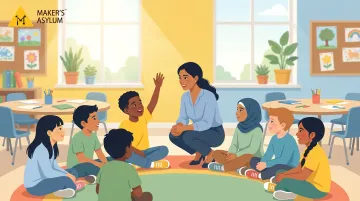
Students will not take intellectual risks—guessing, questioning authority, or admitting confusion—unless they feel safe doing so. Fear of being wrong is one of the biggest suppressors of critical thinking, especially in secondary school where social stakes are high.
ISTE defines classroom psychological safety as a shared belief that interpersonal risk-taking is safe. In psychologically safe environments, students speak up, admit mistakes, and ask for help without fear of judgment.
How to build it:
- Celebrate revised thinking: "You changed your mind based on evidence—that's exactly what strong thinkers do."
- Normalize confusion as part of learning
- Avoid singling out wrong answers as failures
Prior Knowledge and Context
Students cannot critically analyze what they don't yet understand at a basic level. Critical thinking builds on foundational knowledge. The goal isn't to skip comprehension but to move through it efficiently, so students spend more time at the analysis and evaluation levels.
Rushing into analysis before that base is solid leads to shallow reasoning: confident-sounding conclusions with thin evidence behind them.
Signs students may need more context before analysis:
- They agree with the first source they find
- Their arguments rely on personal preference rather than evidence
- They struggle to identify counterarguments
A Growth Mindset Around Being Wrong
Classrooms that celebrate revised thinking build far more critical thinkers than those that only reward correct first answers.
Maker's Asylum's "Make, Break, Create" philosophy puts this directly into practice — iteration and productive failure sit at the center of every program. Students learn that breaking a prototype or revising an argument based on new evidence signals intellectual strength, not weakness.
Key Factors That Shape How Well Students Develop Critical Thinking
Even with the right strategies in place, the rate and depth of development varies. These are the variables that educators and parents have the most control over.
Consistency and Frequency of Practice
Critical thinking is like a muscle—it weakens without regular use. One debate or one PBL project per semester is not enough. It must be woven into daily interactions, across all subjects, as a default mode of engagement.
A formative assessment intervention in Botswana that increased higher-order thinking exercises showed large gains on math tests, with teachers shifting from lower-order to higher-order tasks.
Age-Appropriate Scaffolding
Younger students (middle school) need more structured scaffolding—explicitly labeled steps like "state your claim," "share your evidence," "consider another view."
Older students (high school and beyond) can handle more open-ended, self-directed reasoning tasks. Stanford Medicine notes that early adolescents (11–14) begin applying formal logical operations, while middle to late adolescents (15–18) develop systematic thinking and perspective-taking.
Watch for signs of mismatch: a student who disengages from "too easy" tasks or shuts down under "too complex" ones is telling you the scaffolding needs adjustment.
Quality of Teacher Facilitation
The teacher's role is not to deliver the answer but to engineer the conditions for productive struggle. That distinction matters: a student wrestling with a problem and testing approaches is learning. A student stuck with no pathway forward is just frustrated.
Skilled facilitation means knowing when to ask a guiding question and when to step back entirely.
Exposure to Diverse Perspectives
Students who only interact with people who share their background and beliefs develop narrower reasoning. Broadening that base requires deliberate exposure to:
- Conflicting viewpoints and counterarguments
- Primary sources from different cultural contexts
- Real-world stakeholders with competing interests
- Problems without a single "correct" answer
Common Mistakes That Undermine Critical Thinking Development
Treating Critical Thinking as a Separate Subject
Many schools schedule a "critical thinking lesson" or assign a debate once a term and consider the box checked. In reality, critical thinking must be embedded into every subject, every discussion, and every assignment design.
A high school EFL infusion approach over a school year improved students' critical thinking awareness and skills. The APA Delphi panel recommends integrating critical thinking with subject-matter instruction across all grades.
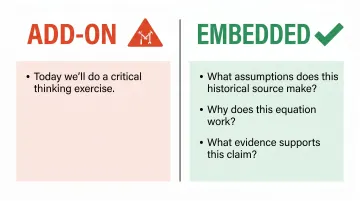
Embedded vs. add-on:
- Add-on: "Today we'll do a critical thinking exercise."
- Embedded: "What assumptions does this historical source make?" "Why does this equation work?" "What evidence supports this claim?"
Prioritizing the Right Answer Over the Reasoning Process
When grading and feedback focus only on whether the conclusion is correct, students learn to guess and memorize—not to reason.
Shifting evaluation criteria to include the quality of reasoning (not just the outcome) changes student behavior and incentivizes deeper thinking. The APA Delphi report recommends evaluating the quality of reasoning processes, not just correctness.
Skipping the Foundational Knowledge Step
Critical thinking about a topic requires understanding it first. Rushing students into analysis before they have adequate context leads to shallow reasoning: confident-sounding conclusions with little substance behind them.
Build foundational knowledge efficiently, then spend most class time on analysis, evaluation, and application.
Frequently Asked Questions
How to develop critical thinking skills in students?
It requires embedding strategies like open-ended questioning, real-world problem solving, and reflective practice consistently across subjects—not as one-off activities. Students need psychological safety, foundational knowledge, and frequent practice to build the skill over time.
How to teach critical thinking skills to high school students?
High schoolers respond well to structured debate, information literacy exercises, and project-based challenges tied to real issues they care about, with less teacher scaffolding so students lead their own reasoning.
What are the 4 C's of critical thinking?
The 4 C's framework includes Critical Thinking, Communication, Collaboration, and Creativity—interconnected core competencies for 21st-century learners.
What is the 3-2-1 thinking strategy?
The 3-2-1 strategy is a reflection tool where students identify 3 things they learned, 2 questions they still have, and 1 way they can apply the knowledge—turning abstract content into something students can act on.
Can critical thinking skills be taught at any age?
Yes. The strategies and complexity of problems are adjusted for developmental stage, but the core habits of questioning, evidence-gathering, and reasoning can start in early childhood and grow more sophisticated over time.
How do you know if a student is developing critical thinking skills?
Observable signs include: the student asks probing follow-up questions, revises their views when presented with new evidence, identifies inconsistencies in arguments, and can articulate the reasoning behind their conclusions rather than just stating them.