Introduction
Today's teenagers are preparing for careers that look radically different from their parents' generation, and many of the skills that will matter most aren't learned in a classroom at all. While schools focus heavily on academic performance, a significant gap exists between what traditional education delivers and what the modern workforce actually demands. Nearly 90% of employers seek problem-solving skills and 80–85% prioritise teamwork, yet only 28% believe recent graduates are adequately prepared in emotional intelligence, time management, or conflict resolution.
This blog covers the essential skills teenagers should develop now to be ready for the careers of tomorrow — from communication and critical thinking to technical fluency and financial literacy. These aren't about being perfect. They're about building habits of learning, making, and experimenting early — so teens arrive at adulthood ready to contribute, not just catch up.
TLDR
- Communication and empathy build professional relationships and help navigate conflict
- Hands-on critical thinking prepares teens for real-world challenges better than passive study
- STEAM literacy and AI awareness are now expected across nearly every career path
- Financial literacy and goal-setting create the independence to follow through on plans
- Adaptability and collaboration are the skills employers value most, consistently
Communication and Emotional Intelligence
Communication is the foundational career skill — it underpins every professional interaction, from job interviews to team meetings to client pitches. Strong communication includes both expressing ideas clearly and listening actively. Nearly 90% of employers seek problem-solving skills and over 80% prioritize teamwork and written communication on resumes, yet most new graduates fall short in these areas.
Verbal and Written Communication
Effective verbal communication means making eye contact, speaking clearly, asking thoughtful questions, and holding your own in group discussions. Written communication — emails, reports, messages — is often where teens struggle most. Professional norms like appropriate tone, clear structure, and consistent follow-through are best learned early, through school projects, emails to teachers, or structured programs.
The habits formed now carry forward. A well-structured email to a teacher today becomes a polished client proposal tomorrow.
Active Listening and Empathy
Active listening — paying full attention, not just waiting to respond — is one of the least-practiced but most valued skills in any workplace. It drives conflict resolution, team collaboration, and customer relationships. Empathy develops through real-world exposure: working on projects with diverse peers, engaging in community initiatives, or collaborating across different perspectives.
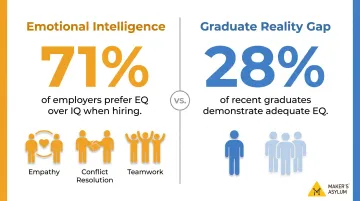
Employers increasingly recognize empathy as a differentiating professional skill. 71% of employers value emotional intelligence over IQ when hiring, yet only 28% say recent graduates demonstrate adequate emotional intelligence. Teens who build these skills now enter the workforce significantly ahead of their peers.
Emotional Regulation
Emotional intelligence doesn't stop at empathy — it also requires managing your own reactions. Self-awareness and emotional regulation help teens handle stress, navigate setbacks, and respond to feedback without shutting down, all of which matter deeply in professional environments.
Harvard research on executive function skills like self-control and flexibility found they are stronger predictors of academic achievement than IQ, with low self-control linked to significantly higher rates of negative adult outcomes. The teen years are the critical window — the prefrontal cortex, responsible for executive function, doesn't fully mature until the mid-20s. What gets practised now gets wired in.
Critical Thinking, Problem-Solving, and the Maker Mindset
Critical thinking is the ability to analyze situations, question assumptions, and arrive at well-reasoned solutions (not just recall facts). As automation takes over routine tasks, this skill has become a hiring priority across industries. McKinsey projects that demand for higher cognitive skills like critical thinking will increase 8-19% by 2030, while basic cognitive skills like data entry will decline 15%.
The Maker Mindset: Learning by Doing
The "maker mindset" is a posture of curiosity, fearless experimentation, and learning through building. Teens who regularly engage in hands-on projects — designing, prototyping, breaking things and fixing them — develop stronger critical thinking than those who only consume information passively.
Take a concrete example: a teen who builds a circuit, writes code to make it work, and troubleshoots when it fails is learning systems thinking, iteration, and problem framing. These skills transfer directly to engineering, design, entrepreneurship, and research careers. Research shows project-based learning has the highest effect size at the high school level (0.720) compared to primary school or university — making the teen years the optimal window for this kind of development.
Maker's Asylum's Innovation School puts this into practice. Students work with hardware kits, electronics, IoT devices, and digital fabrication tools, building projects like air quality monitors and mobile-app-controlled lamps — exploring technical disciplines before they ever have to commit to one.
Breaking Problems Down and Iterating
The professional importance of decomposing a large, complex problem into smaller actionable steps is rarely taught explicitly but is central to project management, product development, and scientific research. Teens who learn to embrace failure as part of the process — rather than a signal to stop — are those who iterate toward solutions.
Research from Stanford University found that a growth mindset intervention improved grades among lower-achieving students and increased overall enrollment in advanced mathematics courses. The ability to view challenges as opportunities for learning rather than threats is what separates teens who persist from those who give up.
Creative and Interdisciplinary Thinking
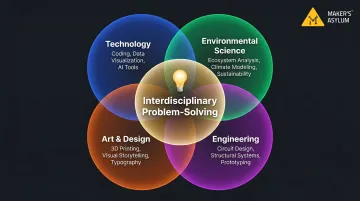
That persistence pays off most when teens also learn to think across disciplines. Engineers who understand social science build better products. Designers who understand data tell stronger stories. Problem-solvers who can draw from technology, art, and environmental science tackle challenges that specialists alone cannot.
Projects blending STEAM fields build this kind of interdisciplinary fluency. A project combining circuit design, 3D printing, and environmental data collection teaches students to think across boundaries rather than within isolated subject silos — and that's a skill set employers across fields are actively looking for.
Technical Skills and Digital Fluency for Future Careers
Technical literacy matters even for teens who don't plan to become engineers. Most careers now involve data, digital tools, automation, and systems thinking. The spectrum ranges from basic coding and hardware understanding to knowing how to use AI tools responsibly.
STEAM Foundations
Foundational STEAM skills for teens look like understanding how technology works, experimenting with electronics or materials, learning basic coding, and engaging with data. The goal isn't to become an expert — it's to remove fear and build fluency.
Maker's Asylum's Innovation School gives teens structured, hands-on exposure to these STEAM disciplines through real-world projects. Students work across:
- CAD and 3D design for digital fabrication
- Electronics and robotics, including Arduino microcontroller programming
- PCB design with soldering practice
- Internet of Things projects using sensors and connected devices
Hardware kits shipped to participants include custom circuit boards like the MakerBee air quality monitor, mini arcade controllers, and IoT lamps controlled via voice and mobile apps.
This approach helps teens discover which technical areas resonate with them before committing to a career path, building confidence through making rather than passive consumption.
Digital Literacy and AI Awareness
Digital literacy is the ability to evaluate information critically, use digital tools effectively, and understand how platforms and algorithms work. This goes beyond "don't believe everything you read online" — it includes evaluating sources, protecting privacy, and using productivity tools efficiently.
AI-related job vacancies grew 33% between 2019 and 2022 across OECD countries, and the World Economic Forum identifies AI and big data as the fastest-growing skill categories globally. Teens don't need to build AI systems — but they should know how to use them responsibly, recognize their limitations, and stay relevant alongside them.
By 2024, roughly 27% of high-skilled job postings required intermediate or advanced digital skills. For teens entering the workforce in the next decade, fluency with digital tools isn't a bonus — it's a baseline expectation.

Financial Literacy, Goal-Setting, and Time Management
Financial literacy — budgeting, understanding credit, saving — is a core independence skill that most teens don't receive formal instruction in. 18% of 15-year-olds in OECD countries lack baseline financial literacy, and most young people enter adulthood with little understanding of credit scores, debt, or compound interest. The basics teens should understand before adulthood include tracking income and expenses, understanding how debt works, and building a habit of saving.
SMART goal-setting (Specific, Measurable, Achievable, Relevant, Time-bound) prepares teens for the self-directed nature of professional careers. Time management — prioritizing tasks, avoiding distractions, working backward from a deadline — reinforces the same habits. Both skills depend on delayed gratification, which builds slowly and is learned through real responsibility rather than instruction alone.
Concrete ways teens can practice these skills include:
- Managing a small budget for a project or event
- Planning their own study schedule with accountability
- Running a small initiative at school or in their community
- Tracking spending for a month and identifying patterns
- Setting a savings goal and working toward it incrementally
Each of these experiences builds the executive function skills that Harvard research identifies as stronger predictors of adult success than IQ.
Leadership, Collaboration, and Adaptability
Leadership shows up in behavior, not titles. For a teenager, that means taking initiative on a group project, stepping up when something needs organizing, or mentoring a peer. Teamwork is sought by approximately 80-85% of employers on college graduates' resumes, and flexibility and adaptability are valued by more than two-thirds of responding employers.
Real collaboration goes beyond dividing tasks and submitting. Research on project-based learning found that collaboration ability had a meaningful positive effect, with optimal results in groups of 4-5 students. Teens who practice it regularly develop skills that solo learners rarely do:
- Working productively with people who have different strengths
- Navigating disagreements without derailing the group
- Sharing credit and holding shared accountability
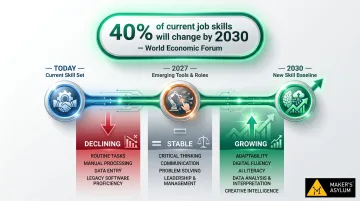
Adaptability is the skill that holds up best as job markets shift — it means learning new tools, adjusting to changing circumstances, and staying effective when plans fall apart. The World Economic Forum projects that nearly 40% of current job skills will change by 2030, meaning teens who are comfortable with uncertainty will have an ongoing advantage throughout their careers.
How Teens Can Start Building These Skills Today
Skills aren't built through reading about them — they're built through doing. The types of environments that accelerate teen skill development include hands-on programs, project-based learning, real responsibilities, and making things that solve real problems.
Practical starting points include:
- Join a makerspace or innovation program where you can work with tools and mentors
- Take on a passion project with a real deliverable — build something tangible
- Volunteer for leadership roles in school clubs or community organizations
- Manage a small budget for an event or initiative you care about
- Build something — anything — from scratch, document the process, and iterate
For teens who want a structured path, Maker's Asylum's Innovation School offers a curriculum where students aged 13+ work on interdisciplinary STEAM projects, develop portfolios, and learn to think and build like innovators. The hybrid program combines online skill-building with a 4–7 day residency in Goa, India, where students prototype real solutions with mentors and peers. Alumni have progressed to universities including MIT, Imperial College London, Columbia, and Cornell, demonstrating that hands-on maker experience translates directly into university admissions and career readiness.
A portfolio — tangible evidence of what a teen has made, solved, or led — is increasingly what opens doors. 90% of companies hiring based on skills rather than degrees report fewer hiring mistakes, and 94% find that skills-based hires outperform credential-based ones.
Top universities and employers are moving in the same direction: demonstrated ability over credentials alone. Every project a teen completes today is direct evidence they can point to tomorrow.
Frequently Asked Questions
What skills should a teenager learn?
Teenagers should focus on communication (verbal and written), critical thinking and problem-solving, technical literacy across STEAM disciplines, financial management, and adaptability. The most valuable skills combine practical and interpersonal abilities, preparing teens for both university and career success.
Why is it important for teenagers to learn life skills?
Developing skills during adolescence builds long-term confidence, independence, and readiness for work and adult life. The teenage brain is uniquely wired for learning complex skills — habits built now tend to stick, shaping how a person thinks and works for years to come.
What soft skills should high school students develop?
High school students should prioritise communication, empathy, collaboration, adaptability, and leadership. These are consistently ranked as the most sought-after traits by employers across industries, with 71% of employers valuing emotional intelligence over IQ when hiring.
What practical life skills should teens learn?
Key practical skills every teen should build include:
- Financial literacy — budgeting, understanding credit, and saving habits
- Time management and goal-setting using frameworks like SMART goals
- Digital fluency across tools relevant to their interests
- Problem-solving through hands-on, real-world projects
What lifelong learning skills should teens develop?
Curiosity, adaptability, and the ability to learn from failure are the most durable skills a teen can develop. When these habits form early, they carry forward — helping people navigate career shifts, new industries, and challenges that don't yet have names.
What skills should a 15 year old learn?
At 15, teens are ready to go beyond the basics. This is an ideal age to explore a specific STEAM interest through a real project — building something, coding a tool, or prototyping an idea. Pairing that hands-on work with emotional regulation and communication practice creates a foundation that directly supports university applications and early career readiness.