Introduction
In a rapidly automating economy, holding a degree is no longer enough. Employers increasingly prioritize demonstrable skills over credentials alone, particularly when hiring young talent. According to the World Economic Forum's Future of Jobs Report 2025, 39% of workers' existing skill sets will become outdated by 2030, and 63% of employers cite skills gaps as the single biggest barrier to business transformation.
Yet "skill development" is widely discussed but rarely examined for its real, day-to-day impact on whether a young person actually gets hired, stays employed, or creates their own opportunities. This article examines what that impact actually looks like — which skills employers value most, how hands-on learning translates to real hiring outcomes, and why early skill-building shapes long-term career trajectories more than any single qualification.
Key Takeaways
- Skill development bridges the gap between academic credentials and real-world employment readiness
- Youth with both technical and soft skills are far more employable than peers with degrees alone — credentials open doors, but skills close offers
- Early skill-building — especially hands-on, project-based work — directly shapes confidence, career clarity, and long-term earning potential
- Hands-on, project-based learning delivers the highest return in skill retention and employer value
- Starting skill development at 13-16 gives teens a compounding advantage — by the time peers begin, they already have a portfolio
What Is Skill Development for Youth?
Skill development is the intentional process of building technical abilities, behavioural competencies, and problem-solving capacities that prepare young people to contribute meaningfully in work and life. The goal isn't to accumulate knowledge — it's to demonstrate capability in real situations.
Two categories matter most for youth employment:
- Technical/vocational skills: coding, digital fabrication, electronics, design tools, data analysis, and domain-specific expertise that employers can test and verify immediately
- Soft/essential skills: communication, adaptability, critical thinking, teamwork, and emotional intelligence — competencies that shape how effectively someone applies technical knowledge on the job
Both are needed. Employers hire for technical ability, but they retain people who can communicate, adapt, and collaborate under pressure.
Key Advantages of Skill Development for Youth Employment
Skill development delivers three measurable advantages directly tied to employability rates, income trajectory, and career readiness.
Advantage 1: Higher Employability and Reduced Time-to-Employment
Youth with documented, practical skills enter the job market with an immediate competitive advantage. They demonstrate capability rather than just potential, shortening the hiring cycle and reducing employer risk.
Why this matters:
89% of HR leaders actively avoid hiring recent graduates. Among those who hired graduates in the past year, 78% admitted they fired at least some. The top reasons: lack of real-world experience (60%) and absence of the right skill sets (51%). Employers want proof, not promises.
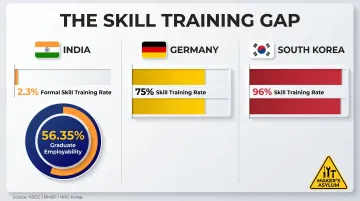
India's skill-demand mismatch is severe. The India Skills Report 2026 found that only 56.35% of Indian graduates are considered employable—meaning 44% lack the practical skills employers need. Compare this to India's formal skill training rate of just 2.3%, versus 75% in Germany and 96% in South Korea.
A young person with a tangible skill portfolio—projects, certifications, working prototypes—shortens their job search, negotiates better starting positions, and reduces dependence on referrals or family connections.
KPIs impacted:
- Time-to-first-employment
- Starting salary levels
- Interview conversion rates
- Rejection rates due to experience gaps
When this advantage matters most:
Critical for first-generation job seekers, students from non-premier institutions, and graduates in sectors where technical ability is immediately testable—tech, design, manufacturing, content creation, hardware development.
Advantage 2: Workplace Readiness Through Soft Skills
Soft skills—communication, teamwork, problem-solving, adaptability—rank as top hiring criteria, yet schools rarely teach or assess them explicitly. Skill development programs, especially project-based and collaborative formats, build these competencies through direct experience.
Why this matters:
94% of workers fear future generations will enter the workforce without necessary soft skills. That same firing pattern breaks down by cause: inability to work well on a team (55%), poor business etiquette (50%), and absence of the right skill sets (51%).
Soft skill gaps are harder to close on the job than technical ones. 91% of HR leaders say onboarding graduates costs more than experienced hires, with 69% reporting it costs at least twice as much.
That cost has a number. Employers estimate saving roughly ₹3,75,000 per hire when a candidate arrives job-ready.
A youth with strong interpersonal and problem-solving skills performs better in teams, escalates issues effectively, and integrates into company culture faster—reducing early-career attrition and accelerating promotions.
KPIs impacted:
- 90-day retention rates for new hires
- Team performance scores
- Promotions within first year
- Employer satisfaction ratings
When this advantage matters most:
Especially critical in client-facing, collaborative, or leadership-track roles—and for youth entering mid-to-large organizations where cultural fit is evaluated alongside technical fit.
Advantage 3: Entrepreneurial Confidence and Self-Reliance
Not all youth employment is traditional employment. India's gig workforce is projected to reach 23.5 million by 2029-30, and the paths young people take—freelancing, gig work, founding ventures—demand the same practical skills as formal jobs. Skill development builds the confidence and capability to pursue all three.
Why this matters:
71% of Gen Z freelancers are already receiving AI training to stay competitive, and 37% of Gen Z graduates are pursuing blue-collar or non-traditional work—seeking stability and automation-resistant roles rather than conventional career tracks.
Practical skill-building trains young people to take initiative, manage uncertainty, and create value independently—particularly in environments that encourage experimentation and real-world problem-solving.
Entrepreneurial confidence compounds over time. Youth who develop it early are more likely to innovate, take on stretch roles, and eventually create employment for others.
India's context amplifies this advantage. With 367 million people aged 15-29—one-third of the working-age population—the country is in the mid-window phase of its demographic dividend, peaking between 2030 and 2040. A generation of skilled, self-reliant youth creates economic multiplier effects beyond individual employment.
KPIs impacted:
- Self-employment rates
- Startup formation among youth
- Freelance income trajectories
- Long-term income growth
When this advantage matters most:
Most impactful in sectors with low formal employment but high demand for independent skilled work—design, tech, content, sustainability, manufacturing. Also critical in Tier 2/3 cities where formal job markets are smaller and a single skilled individual can anchor an entire local supply chain.
What Happens When Skill Development Is Neglected
The consequences of entering the workforce without intentional skill development are measurable and serious:
- Prolonged unemployment: Only 7% of unemployed graduates in India secure a permanent salaried job within one year of finishing education. India adds 5 million graduates annually, but only 2.8 million find any form of employment, and just 1.7 million enter salaried work.
- Mis-matched careers: Without practical experience, young people struggle to articulate what they can do — and 83% of engineering graduates end up in roles unrelated to their field.
- Credentials without capability: Degrees without skills create a cycle where advancement stalls. 52% of new graduates globally work in jobs that don't use their degree or credential.
- Employer reluctance to hire young talent: When new hires require extensive reskilling, hiring managers pull back. 37% of HR leaders would rather have a robot or AI do a job than hire a recent graduate. 30% would rather leave a position unfilled.
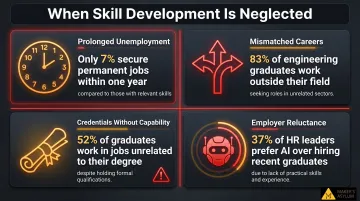
These aren't outlier cases. With only 56.35% of graduates considered employable and just 2.3% of workers having received formal skill training, India is sitting on a compounding problem. Every year without intervention is another cohort entering the workforce underprepared — and employers increasingly unwilling to give them a chance.
How to Get the Most Value from Skill Development
Skill development delivers the highest return when it is consistent, experiential, and tied to real outputs, not limited to classroom instruction or one-off workshops.
Hands-on practice over passive learning
Skills built through doing—building, designing, coding, presenting, failing, iterating—are retained and demonstrated more effectively than those absorbed through lectures. Research on project-based learning (PBL) shows motivation scores increased 48.4% and engagement rose 56.7% when moving from traditional to PBL methods.
Experiential learning also predicts skill transfer outcomes. A 2025 study by Ho and Lau found that experiential learning explained 49% of variance in the ability to apply skills spontaneously in new contexts.
Reflection and naming
Young people gain more from skill-building experiences when educators and mentors explicitly name the skills being developed — "what you just did is called systems thinking" or "you demonstrated design thinking by iterating on user feedback." This metacognitive layer makes skills transferable and easy to communicate to employers or universities.
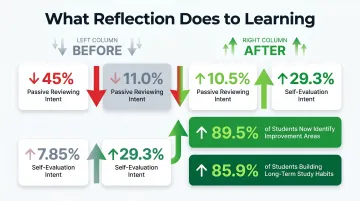
Research using reflection tools found measurable shifts in how students approach learning:
- 89.5% said the tools helped identify areas for improvement
- 85.9% developed effective long-term study habits
- Intent to use passive reviewing dropped from 45% to 10.5%
- Intent to use self-evaluation rose from 7.85% to 29.3%
Portfolio documentation
Outcomes compound when youth can show their work. A portfolio of projects is increasingly valued by universities and employers over grades alone. Project-based hiring rose 38% in FY25 among Indian employers, and 92.8% of candidates seek internship opportunities to build practical experience and bridge skill gaps.
Programs like Maker's Asylum's Innovation School are designed around exactly this model: learning by making, working on real-world challenges, and building a documented portfolio of interdisciplinary STEAM projects. Students carry that portfolio directly into university applications and job interviews.
Conclusion
Skill development is not a supplementary activity for youth—it is the primary mechanism through which they become employable, confident, and adaptable in a fast-changing economy. Its advantages compound: the earlier and more consistently a young person develops practical skills, the faster they close the gap between education and employment.
Already, 39% of existing skill sets are projected to become outdated by 2030, and employers worldwide are shifting toward skills-based hiring. Youth who invest in demonstrable competencies today position themselves for career success tomorrow.
The most effective approach treats skill development as an ongoing practice woven into a young person's education — not a one-time course taken in a panic when job applications come back empty. Programs like Maker's Asylum's Innovation School and SDG School are built on exactly this principle: structured, repeated, hands-on learning that compounds over time and translates directly into real-world readiness.
Three things to carry forward:
- Start early — skills built in the teen years create a longer runway for growth
- Prioritise doing over knowing — demonstrable competencies matter more than credentials alone
- Treat learning as continuous — the students who stay curious stay competitive
Frequently Asked Questions
Why is skill development important for youth?
Skill development bridges the gap between academic education and employer expectations, directly improving a young person's chances of finding and keeping meaningful employment. With 63% of employers citing skills gaps as their primary barrier to business goals, practical competencies have become more valuable than credentials alone.
What are the most important skills for youth?
Youth need two key categories: technical/vocational skills (digital tools, coding, fabrication, design) and soft skills (communication, problem-solving, teamwork, adaptability). Research shows 94% of workers fear Gen Z will enter the workforce without adequate soft skills, while 70% of organisations plan to hire for new technical roles—making both equally critical to employability.
Is skill development bridging the gap for India's youth?
While India has made significant investments in skill development through national programs, a gap between formal skilling initiatives and industry-ready employability remains. PMKVY phases 1-3 placed only 41% of certified candidates, though phase 4.0 reports improvement to 76% placement rates—pointing to the need for more experiential and outcome-linked training.
What are the 4 pillars of skill development?
The widely referenced pillars are: technical/vocational skills, soft/behavioural skills, digital literacy, and entrepreneurship. Each addresses a distinct dimension of readiness—from hands-on capability to the collaborative and adaptive thinking employers now prioritise.
How can hands-on learning help with youth skill development?
Hands-on learning accelerates skill retention by placing youth in real problem-solving contexts—they practice communication, critical thinking, and technical skills simultaneously. Project-based learning produces 48.4% motivation gains and 56.7% engagement gains over traditional methods, making the learning longer-lasting and easier to demonstrate to employers.
At what age should skill development begin for youth?
Foundational skill development can begin as early as middle school (around age 12-13), when students can meaningfully engage with project-based learning and basic technical tools. Starting early allows skills to compound over time and become part of a documented portfolio—an advantage when applying to competitive universities or programmes.