Introduction
Across India, millions of youth are eligible for skill development programs, yet seats go unfilled — not because young people lack ambition, but because programs fail to reach them effectively. According to the Periodic Labour Force Survey 2023-24, only 4.1% of Indians aged 15-59 have received formal vocational training, leaving approximately 353 million youth without the skills needed for today's economy.
Youth mobilization — the process of identifying, reaching, and motivating young people to enroll in and complete training — addresses this gap directly.
The challenge cuts both ways. Organizations have programs ready to deliver, while youth from underserved communities lack access, awareness, or the confidence to show up. PMKVY completion rates collapsed from 100% in Phase 1.0 to just 23% in Phase 4.0, signaling a structural breakdown in how programs reach and retain participants.
Fixing that breakdown requires rethinking outreach from the ground up. This guide covers practical mobilization strategies, common barriers and how to overcome them, aspiration mapping frameworks, and how peer and community ecosystems strengthen both reach and retention.
Key Takeaways
- Effective mobilization rests on four pillars: targeted outreach, community trust, aspiration alignment, and peer networks
- Programs lose youth when trust is low, parents are excluded, or the offer doesn't match what young people actually want
- Retention improves with mentorship, visible progress milestones, and giving youth real ownership over their learning journey
- Digital channels now drive 62% of enrollment leads at 3–10× lower cost than print
Why Youth Mobilization Fails: Common Challenges
The Trust Deficit
When youth and their families have no prior relationship with a training provider, skepticism is natural — especially when previous programs overpromised and underdelivered. PMKVY placement rates plummeted from 12.7% in Phase 1.0 to just 0.37% in Phase 4.0, eroding trust that certificates lead to careers. According to the Smile Foundation, 7 out of 10 youth are economically disengaged due to lack of market-ready skills. When young people see peers complete training but remain unemployed, enrollment becomes a hard sell.
Aspiration-Reality Mismatch
Programs are often designed around what institutions can deliver, not what youth want to do or where they see their future. Field research in Rayagada, Odisha revealed that training programs focus on textiles and beauty services requiring migration, while youth strongly prefer stable local or government jobs. One 21-year-old trainee captured the dilemma directly: "My parents won't send me outside Odisha. Most jobs offered after training were in other states, so even if I complete the course, I may not be able to take the job."
Even when distant placements offer ₹10,000–12,000 per month against local wages of ₹6,000–7,000, youth routinely decline — cultural ties, dietary adjustment, and family pressure outweigh the wage difference. This misalignment between offered skills and actual career aspirations drives attrition even after enrollment.
Structural and Social Barriers
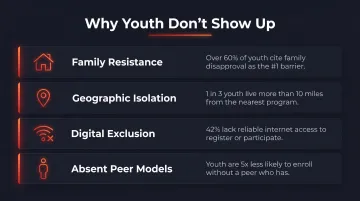
For girls and rural youth especially, the barriers go beyond program design. Only 27.4% of young women were employed in 2022, compared to 40.3% of young men — a gap that structural obstacles actively maintain:
- Family resistance: Parents block residential training over safety concerns, cultural norms, and household responsibilities
- Geographic isolation: In some areas, reaching the nearest bus stop requires walking more than 5 km
- Digital exclusion: An estimated 90% of adolescent girls and young women in low-income areas lack internet access, cutting off digital enrollment pathways
- Absent peer models: Without visible examples of women who completed training and found stable work, enrollment feels like a gamble
Indian socio-cultural norms compound this further — manual and blue-collar work carries low social status, which dampens demand for vocational training regardless of wage potential. Until programs can point to visible, respected outcomes in participants' own communities, these barriers will continue to suppress enrollment before it even begins.
Step-by-Step: How to Mobilize Youth for Skills Training
Step 1 — Map the Target Community
Before any outreach, conduct a ground-level audit. Understand which age groups are present, their job aspirations, mobility preferences, and existing awareness of skill programs. In Rayagada, for example, families were willing to send youth to local training but systematically refused residential programs requiring out-of-state relocation.
Skipping this step leads to wasted outreach budgets and low-quality enrollment. You might design a program around textiles when youth overwhelmingly prefer agriculture or local manufacturing. You might assume digital outreach will work when 90% of young women in the area lack internet access.
Key questions to answer:
- What age groups and education levels are present?
- What careers do youth and families see as stable and respectable?
- Are youth willing to relocate for training or employment?
- How do youth currently discover education opportunities?
Step 2 — Identify and Activate Local Connectors
Programs that work through existing community networks see better reach than those using cold outreach alone. Trusted community figures create first-point-of-contact trust — teachers, self-help group (SHG) members, religious leaders, local influencers, and shop owners all serve as effective entry points.
Ambuja Foundation deploys 54 community mobilizers using multiple outreach methods: door-to-door contact, focus group interactions, night meetings with communities, direct parent meetings, social media advertising, and volunteer engagement. This multi-channel approach has yielded 134,000 graduates across 51 centers with a 77% placement rate.
The "role model effect" is real: when Leena Sahu from Bhatapara, Chhattisgarh completed retail management training and was immediately placed, her success brought 60 more youngsters from her village to sign up. Visible outcomes through community-embedded alumni move enrollment far more than any external marketing campaign.
Research on self-help groups confirms that SHGs serve as effective platforms for delivering development programs by leveraging pre-existing trust and relational infrastructure. In rural areas where formal institutional trust is low, SHG networks lower mobilization costs and extend reach organically.
Step 3 — Run Aspiration-Mapping Sessions Before Enrollment
Instead of jumping to sign-ups, host informal sessions that help youth visualize their interests, explore career pathways, and understand what a specific skill program can do for their future.
Tata STRIVE developed Karyapath, a picture-based, gamified, language-agnostic career assessment tool designed to overcome literacy and language barriers. The tool pairs with career discovery videos offering realistic "day-in-the-life" views of job roles. The core premise: "When there is a personality-job fit, there are greater chances of students staying on the job."
The West Bengal government has adopted the tool and is promoting it to other state governments — a sign that aspiration mapping at scale is gaining policy traction.
Career and Technical Education research confirms that providing exploratory opportunities before pathway selection reduces student "misplacement" and boosts engagement and retention. Effective models allow 9th graders to rotate through 3-6 different program areas before committing to a specific pathway.
Practical aspiration-mapping tools:
- Picture-based interest inventories
- Job shadowing visits to worksites
- Alumni panel conversations
- Career exploration workshops
- One-on-one counseling sessions
Youth who actively choose their pathway — rather than being placed into one — show measurably lower dropout rates and stronger on-the-job retention.
Step 4 — Design Awareness Campaigns That Speak to Youth Culture
Social media reels, maker fairs, community demos, and "try before you commit" open days outperform flyers and banners. Youth mobilization today must happen both in physical spaces (community halls, school campuses) and digital channels (WhatsApp groups, Instagram, YouTube).
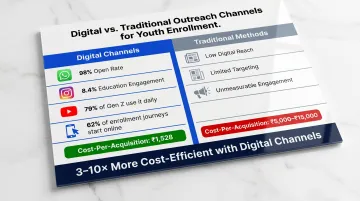
The numbers make a clear case for digital-first outreach:
- 62% of enrollment journeys now start on digital channels, with 72% of leads coming online
- WhatsApp delivers a 98% open rate — compared to roughly 20% for email
- Instagram achieves 8.4% engagement in education, the highest of any industry
- 79% of Gen Z students in India use YouTube daily
Digital cost-per-acquisition averages ₹1,528, compared to ₹5,000-15,000 for traditional methods — a 3-10× efficiency gap that makes digital-first mobilization economically necessary for resource-constrained organizations.
Maker's Asylum uses hands-on open sessions to let youth experience the learning format firsthand before enrolling in the Innovation School. Their mobile makerspace, "Maker Auto," travels across cities hosting collaborative workshops by partnering with educational institutions, community groups, and nonprofits, bringing innovation experiences directly to communities.
Step 5 — Build Parent and Guardian Buy-In as a Parallel Track
For youth aged 13-20, family hesitation is often the final block to enrollment. Running a parallel parent counseling track — sharing program outcomes, safety assurances, and success stories from alumni — can dramatically improve conversion from interested youth to enrolled participants.
Ambuja Foundation runs direct parent meetings as part of its mobilization strategy. The organization has trained 42,000+ girls (approximately 40-44% of total trainees), demonstrating that intentional family engagement overcomes gender-based enrollment barriers.
Key elements of parent counseling:
- Safety assurances for residential or out-of-state programs
- Clear communication about placement rates and starting salaries
- Testimonials from alumni who now support their families
- Workplace visits where parents see the actual job environment
- Addressing cultural or dietary concerns about relocation
Building the Right Ecosystem: Community, Peers, and Partners
Mobilization as an Ongoing Ecosystem
The difference between mobilization as a one-time campaign and mobilization as an ongoing ecosystem is retention. Programs that build a social environment around learning — where peers, mentors, alumni, and institutional partners all play active roles — sustain higher enrollment and lower dropout rates.
Research by Boat, Miranda, and Syvertsen (2021) studied 841 emerging adults and found that peer social capital has a strong effect on self-initiated social capital (beta = 0.49-0.51), meaning peers are the primary drivers of a student's ability to advocate for themselves and access resources. Near-peer social capital had a direct effect on progress toward education and career goals (beta = 0.18). The models explained 48% of the variance in goal progress.
Four Types of Social Capital Mobilization
Based on research frameworks, programs should design for four pathways:
Self-initiated: Youth seek out programs themselves after seeing social media content, hearing about outcomes, or discovering through independent research. Optimize for this by maintaining strong SEO, active social channels, and clear program information.
Connection-initiated: Peers or mentors refer youth directly. This is the highest-trust pathway. Alumni who land jobs become organic recruiters when they share their success.
Organizationally-driven: The program creates structured referral events — open houses, school visits, community fairs, demo days. These create formal touch points with new audiences.
Individually-driven: Informal one-on-one introductions by educators, counselors, or community figures. Building these relationships with trusted connectors takes time, but they generate some of the most durable referrals.
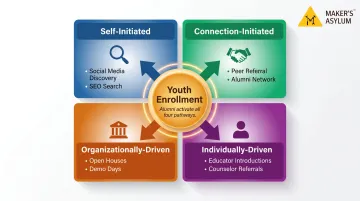
Alumni sit at the center of all four pathways — but they're most powerful when programs treat them as active mobilizers rather than passive proof points.
Alumni as the Most Credible Mobilizers
A youth from the same neighborhood who completed a program and landed a job or built something real is far more persuasive than any brochure. Ambuja Foundation operates 17 alumni chapters with 20,000 engaged members who serve as a social support system for new graduates and help them settle into new locations, build cultural confidence, and advance careers through WhatsApp groups. This alumni infrastructure also drives organic mobilization as graduates become visible proof points in their home communities.
Maker's Asylum's alumni network spans 400+ students across 40+ countries, with placements at MIT, Stanford, Cambridge, and IIT. When prospective students see peers from their own background thrive in those environments, the network does its own recruiting.
A Strada-Gallup Alumni Survey found that only 9% of college graduates reported their alumni network was helpful in the job market. However, Fisher and Price (2021) identified four high-impact functions for reimagined alumni networks: mentors for student persistence, career advice and referral sources, experiential learning providers, and staff for program delivery. Skill programs that formalize these roles — rather than leaving alumni engagement to chance — are the ones that close that gap.
Institutional Partnerships to Expand Reach
Alumni build credibility from the ground up. Institutional partnerships work from the top down — and together, they cover the full trust spectrum. When reputable institutions co-sign a program through joint events, shared communications, or formal referral pipelines, it lowers the trust barrier for new enrollees.
Maker's Asylum partners with UNESCO, UNDP, Monash University, HDFC Bank, and various schools and NGOs globally. These partnerships open direct recruitment pipelines — university networks refer students, and CSR-funded scholarships remove financial barriers before they become enrollment barriers. The Plastic Safari initiative reached 4,500+ students across Mumbai schools through partnerships with Hindustan Unilever, XYNTEO, RaddiConnect, and the Academy of Earth Sustainability.
Equity in Mobilization
Outreach strategies must be intentionally designed to reach youth who face additional barriers. Programs that don't plan for inclusion in their mobilization design will consistently underserve the most marginalized groups.
Equity-focused mobilization in practice looks like:
- Targeted outreach to girls in conservative households, SC/ST communities, and differently-abled youth
- Ambuja Foundation's model of training 42,000+ girls through structured community programs
- Maker's Asylum's 50+ scholarships through mission-aligned school partnerships, grounded in the belief that "access to innovation should be universal"
- CSR-funded scholarships that remove financial barriers before they become enrollment barriers
Mapping Aspirations: Connecting Youth to the Right Skill Path
Beyond Interest Surveys
Aspiration mapping goes further than interest surveys. It's a structured conversation that connects a young person's current reality, personal strengths, and future goals to a specific program or career pathway.
Tata STRIVE's Karyapath tool operationalizes this by matching youth personality profiles to specific job roles before course selection. The tool's adoption by a state government validates the approach at institutional scale. The same logic applies wherever youth choose between distinct tracks — whether that's engineering innovation, sustainability challenges, or hardware entrepreneurship. Matching the person to the pathway first makes everything downstream easier.
Practical Tools and Approaches
- Picture-based interest inventories: Overcome literacy barriers by using images that represent different careers and work environments
- Job shadowing visits: Let youth spend a day observing professionals in real workplaces
- Alumni panel conversations: Graduates share honest accounts of what training was like and how it shaped their careers
- Career exploration workshops: Interactive sessions where youth try hands-on tasks from different fields
- One-on-one counseling: Personalized guidance that accounts for family constraints, financial reality, and personal strengths
These tools do more than surface preferences — they guide youth toward programs where they're more likely to stay and succeed. Programs should invest in this phase as seriously as they invest in curriculum design.
Using Data to Improve Program Design
Aspiration-mapping sessions generate detailed, firsthand insight into what youth actually want. Programs that loop this feedback into curriculum updates, timing choices, and outcome promises will mobilize more effectively in subsequent cohorts.
If 80% of youth in a region express interest in agriculture tech but your program offers only garment manufacturing, you've discovered a mismatch worth fixing before spending another rupee on outreach.
Sustaining Engagement Beyond Enrollment
Mobilization Doesn't End at Enrollment
The real test is whether youth complete the program, apply their skills, and stay connected to the community. NAPS apprenticeship dropout rates surged from under 1% in FY2018-19 to 35% in FY2024-25, revealing that enrollment alone guarantees nothing.
Key levers that sustain engagement:
- Visible learning milestones: Break programs into achievable modules with certificates or badges at each stage
- Peer accountability groups: Small cohorts (5-8 students) that check in regularly and support each other
- Meaningful projects tied to real problems: Youth stay motivated when work has purpose beyond exercises
- Access to mentors who respond: Near-peer mentors or industry experts who provide timely feedback
Psychological Ownership Drives Retention
Research by Fei et al. (2025) studied 320 undergraduates and found that psychological ownership — the affective-cognitive state where a learner perceives a learning experience as "mine" — is the strongest predictor of class stickiness (beta = 0.95, p < .001). Ownership is driven by four empowerment dimensions:
- Autonomy: Choosing learning paths and project topics
- Competence: Feeling capable and seeing skill growth
- Meaning: Alignment with personal values and career goals
- Impact: Ability to influence course content or outcomes
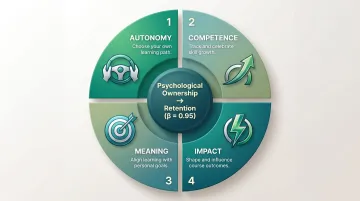
When youth feel they are contributors to a learning community — not just recipients of training — dropout rates fall. Giving youth agency in program decisions (project topics, presentation formats, skill electives) fosters this ownership.
Maker's Asylum builds this into its program structure: students define their own problem statements, choose the tools they'll use, and build prototypes around issues they actually care about. Mentors from industry and academia give feedback on real work — not hypotheticals — which makes the learning feel consequential from day one.
Post-Program Follow-Up as a Mobilization Tool
Youth who feel supported after completing a program become advocates. Ambuja Foundation's alumni chapters and WhatsApp groups show what sustained post-placement infrastructure looks like — and why it matters. Programs that cut off contact at graduation see sharp dropout from community; those that maintain touchpoints keep alumni engaged as advocates and re-enrollers.
Near-peer mentoring research reinforces this. Alumni "Captains" placed with small cohorts of 5-8 students — guiding curriculum and running check-ins — consistently show improvements across:
- Self-esteem and academic achievement
- Peer relationships and sense of belonging
- Reduced depressive symptoms and substance misuse
Frequently Asked Questions
How to mobilize youth for skills training?
Effective mobilization starts before the first enrollment session. Key actions include:
- Map the community and identify trusted local intermediaries
- Run career exploration sessions to surface youth aspirations
- Engage parents in parallel, not as an afterthought
- Activate peer networks to build word-of-mouth interest
What are the 5 stages of skill development?
The commonly referenced stages are: awareness/interest, aspiration mapping, training/learning, practice/application, and assessment/certification. Mobilization primarily activates the first two stages, ensuring youth discover programs and align their goals before formal training begins.
What are the 5 skills of youth empowerment?
The core skills associated with youth empowerment are: communication, critical thinking, leadership, self-awareness, and collaborative problem-solving. Programs that build these alongside technical skills consistently see stronger outcomes and higher retention.
What are the biggest barriers to youth participation in skill programs?
The most common barriers include:
- Low trust in program providers
- Family resistance, particularly for girls
- Skills offered don't match personal aspirations
- Fear of relocation or leaving home
- Low perceived wage returns at entry level
Addressing these requires community-embedded outreach, parent counseling, and aspiration-aligned program design.
How do you sustain youth engagement after they join a skill program?
Key retention tactics include:
- Build peer communities early in the program
- Create visible progress milestones learners can celebrate
- Assign project-based work with real stakes
- Provide mentorship access and give youth agency within the structure
When learners feel genuine ownership over a program, retention follows naturally.
What role do parents and families play in youth mobilization?
Family buy-in is often the deciding factor for youth aged 13-20. Running parallel parent counseling sessions — with safety assurances, alumni stories, and clear placement outcomes — significantly improves enrollment conversion. This matters most for girls and youth from conservative households.