TL;DR
- Creative thinking is teachable through structured practice, not an innate gift
- Build it through open-ended problems, brainstorming, collaboration, and hands-on making
- Classroom environment, teacher mindset, and practice frequency matter as much as activities
- Psychological safety, real-world relevance, and quality feedback significantly impact results
- Avoid treating creativity as a one-off event, over-structuring tasks, or skipping reflection
What Does Developing Creative Thinking in Students Really Mean?
Creative thinking isn't simply "being artistic." UNESCO defines it as the ability to generate novel ideas, experiment with alternatives, evaluate possibilities, and apply imagination to solve problems. It sits at the top of Bloom's Revised Taxonomy under "create"—making it the culmination of deeper learning, not a soft add-on.
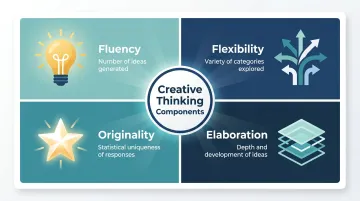
Creative thinking involves two cognitive processes working together: divergent thinking (generating many possibilities) and convergent thinking (evaluating and refining them). Students need both. Research shows creative thinking breaks down into four measurable components:
- Fluency — number of ideas generated
- Flexibility — variety of categories explored
- Originality — statistical uniqueness of responses
- Elaboration — depth and development of ideas
Why It Matters for Students Today
Beyond test scores, creative thinking prepares students for career readiness and problem-solving in a rapidly changing world. A 2011 longitudinal study analyzing 272,599 students found U.S. creativity scores have declined since 1990, with the sharpest drops in younger students. Without deliberate practice, creative capacity atrophies.
How to Develop Creative Thinking Skills in Students
Step 1: Use a Clear Framework to Break Creative Thinking into Teachable Components
Without a defined framework, "teach creativity" becomes too vague to act on. Break creative thinking into observable aspects:
- Fluency – number of relevant ideas generated
- Flexibility – variety of categories or approaches
- Originality – statistical rarity or uniqueness
- Elaboration – level of detail and development
Focus on one aspect at a time. Use it as a lens for both instruction and assessment. This gives students a vocabulary to monitor their own thinking and makes improvement measurable.
Step 2: Assign Ill-Defined, Open-Ended Problems
Well-defined problems with known solutions don't require creative thinking. Students need ill-defined challenges that allow multiple valid solutions and encourage possibility thinking. Research on instructional design confirms that formal education overemphasises well-structured problems, limiting students' ability to tackle complexity.
Tie these problems to real-world or community contexts. A 2022 study found that real-world problem-based maker education enhanced student creativity across novelty, utility, aesthetics, and authenticity. Real stakes and genuine audiences push students further than any textbook exercise can.
For example, at Maker's Asylum's Innovation School in Goa, students tackled river pollution by designing a remote-controlled cleanup bot using plastic bottles for buoyancy—an affordable, scalable solution to a real environmental problem.
Step 3: Structure Brainstorming and Divergent Thinking Activities
Brainstorming isn't just about quantity: the real goal is producing a range of ideas across different categories, using volume as a path to originality. Prompt students to pause and reflect: "Are these all the same idea restated? What categories can we identify? What falls outside these categories?" This pushes beyond obvious responses.
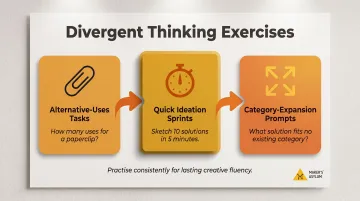
Meta-analysis shows that simply instructing students to "be creative" increases originality by approximately 0.79 standard deviations. Embed timed divergent thinking exercises regularly:
- Alternative-uses tasks (e.g., "How many uses can you find for a paperclip?")
- Quick ideation sprints (e.g., sketch 10 solutions in 5 minutes)
- Category-expansion prompts (e.g., "What's a solution that doesn't fit any category we've listed?")
These short, low-stakes exercises build creative fluency when practised consistently.
Step 4: Build in Collaboration and Structured Peer Feedback
Once students build individual fluency, collaboration sharpens it. Peers help each other elaborate ideas, identify blind spots, and see problems from different angles. Research on collaborative learning shows group collaboration can improve individual creative-thinking ability when properly facilitated.
Frame peer feedback using "What if…?" or "Could you…?" question formats to keep it generative rather than evaluative:
- Instead of "That won't work," encourage "What if you tried combining X with Y?"
- Instead of "I don't get it," ask "Could you show me how this part functions?"
This keeps the creative process open while still offering useful input. At Maker's Asylum, students work in global cohorts during pre-residency online calls, deliberately placed in new groups with unknown peers from different countries. This challenges assumptions and introduces diverse perspectives before hands-on building begins.
Step 5: Make It Hands-On — Learning Through Making and Doing
Hands-on, project-based learning is one of the most effective contexts for creative thinking. Students must apply ideas, test them, iterate on failures, and find novel solutions under real constraints.
A 2019 study with middle school students found that a prototyping intervention increased iterative practices and led to more constructive reactions to failure. Structured making environments put this directly into practice: students prototype, hit dead ends, revise, and try again.
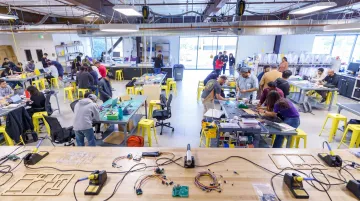
Maker's Asylum's Innovation School, built on a "Make, Break, Create" philosophy, offers one model of how this works in practice. Students begin with 50 hours of online skill-building in CAD, electronics, and robotics, then spend 7 days at a 10,000+ sq ft makerspace in Goa.
During the residency, they receive hardware kits (circuit boards, mini arcades, IoT lamps) and work with real tools to build functional prototypes:
- 3D printers and laser cutters for fabrication
- Soldering stations for electronics assembly
- Mentors and peers from across 40+ countries for feedback and iteration
What You Need Before You Start Building Creative Thinking in Your Classroom
How well students develop creative thinking depends heavily on conditions established before any activity begins. Preparation shapes outcomes.
Psychological Safety and Classroom Culture
Students won't take creative risks—generate unusual ideas, challenge assumptions, or embrace ambiguity—if they fear being wrong or judged. Research in project-based learning found psychological safety correlated positively with creativity (r ≈ 0.45).
Establish a culture where mistakes are treated as learning data. Model this explicitly:
- Celebrate failed experiments that taught something useful
- Share your own creative missteps and what you learned
- Reframe "I don't know" as "Let's explore that together"
The Teacher's Mindset and Role
Teachers serve as both role model and facilitator. You need to:
- Demonstrate curiosity and model asking open questions
- Resist rushing to supply answers
- Show comfort with uncertainty
Your willingness to experiment directly affects students' willingness to do the same. Assigning only problems with known solutions teaches students that creativity is a performance — not a genuine process.
Access to the Right Tools and Prompts
Open-ended materials, varied media, making tools, and well-designed prompts all feed creative development. A well-equipped classroom — or even a dedicated makerspace — gives students the room to experiment without friction.
Even without expensive equipment, provide:
- Cardboard, tape, scissors, markers for rapid prototyping
- Access to basic digital tools (free CAD software, coding platforms)
- Open-ended challenge prompts tied to students' lived experiences
Key Factors That Shape How Well Students Develop Creative Thinking
Two classrooms can use the same activities and produce very different results. Outcomes depend on several underlying variables.
Consistent, Frequent Practice
Creative thinking is a skill that weakens without regular use. Sporadic "creative days" are far less effective than embedding short creative exercises across subjects and throughout the week. A comprehensive 2024 meta-analysis of 169 creativity-training studies spanning five decades confirms that sustained, structured practice improves creative performance (adjusted effect ~0.29–0.32 SD).
Weekly embedding strategies:
- Start each lesson with a 3-minute divergent thinking warm-up
- Assign one open-ended homework task per week across subjects
- Replace one traditional quiz per month with a creative challenge
Process-Focused Feedback
Students need specific, process-focused feedback on their creative thinking—not just "good job" or a grade on the final product. Effective feedback addresses:
- The quality of their idea generation (Did they explore multiple categories?)
- How they refined ideas (Did they iterate based on constraints?)
- How well they evaluated alternatives (What criteria did they use?)
Generic praise doesn't help. "You thought of 12 ideas—I noticed 3 different categories. Can you push into a fourth category?" gives students actionable direction.
Authentic Problems Students Actually Care About
Creativity flourishes when students care about the problem. Authentic challenges connected to their community, environment, or lived experience generate deeper engagement and more original responses than abstract exercises.
This plays out clearly in practice: at Maker's Asylum, students tackle sustainability challenges like designing low-cost air quality monitors or building products for underserved communities. One alumna developed a safety product for sewage workers and filed her first patent as a result.
Metacognitive Awareness of the Creative Process
Students who understand what creative thinking is and can reflect on their own creative process develop faster. Research in STEM-based online learning reported improvements in students' metacognitive abilities alongside gains in creative thinking skills.
Explicitly teach students the aspects of creativity (fluency, originality, elaboration). Give them a vocabulary to monitor and improve their own thinking. After a brainstorming session, ask:
- "Which phase felt easiest—generating ideas or refining them?"
- "Did you notice yourself self-censoring ideas? Why?"
- "What category of solution didn't you explore yet?"
Students who can answer these questions aren't just completing activities—they're building a mental model of their own creative process that transfers across subjects and problems.
Common Mistakes That Hold Back Creative Thinking in Students
Treating Creativity as a One-Off Event
Scheduling a single "creative project" per term and treating the rest of learning as rote sends the message that creativity is a bonus, not a core skill. Educators must weave it consistently across subjects and lessons.
Over-Structuring Creative Tasks
Adding too many constraints, grading rubrics for "correctness," or narrowing problem parameters defeats the purpose. Tasks must preserve genuine openness. Educators need to actively calibrate the balance — enough structure to scaffold, enough freedom to actually create.
For example, instead of "Build a bridge with exactly 50 popsicle sticks that holds 2kg," try "Design a structure using available materials that solves a weight-bearing problem you identify." The second version opens problem space; the first closes it.
Skipping the Feedback and Reflection Loop
Many educators run creative activities but don't build in time for students to reflect on their own process or receive targeted feedback. Without this loop, students repeat the same patterns instead of growing as creative thinkers. A complete feedback cycle includes:
- Self-evaluation of what worked and what didn't
- Peer critique focused on process, not just the final output
- Targeted educator feedback that builds on both
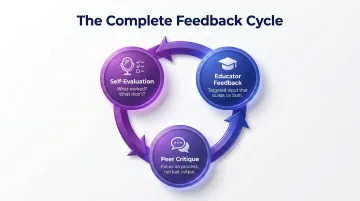
These steps are as important as the creative activity itself.
Frequently Asked Questions
How to improve creative thinking in students?
Improve creative thinking through consistent practice with open-ended problems, structured brainstorming, collaborative feedback, and hands-on making. It's a skill built gradually through deliberate activity, not a talent switched on overnight.
What are the 7 C's of creativity?
Lubart's 7 C's framework organises creativity scholarship into Creators, Creating, Collaborations, Contexts, Creations, Consumption, and Curricula — covering who creates, how, with whom, under what conditions, what they produce, how it's received, and how it's taught.
What are the 5 A's of creativity?
Glăveanu's 5 A's model defines Actor, Action, Artifact, Audience, and Affordances as a framework for understanding the creative process. It applies directly to students producing and evaluating creative work.
What are the 7 critical thinking skills?
The Delphi Report identifies six core critical thinking skills: Interpretation, Analysis, Evaluation, Inference, Explanation, and Self-Regulation. Critical thinking (evaluating existing ideas) differs from creative thinking (generating new ones), though both are essential and mutually reinforcing.
Can creative thinking be taught, or is it a natural talent?
A 2024 meta-analysis spanning five decades confirms creativity training measurably improves creative output. The myth of a fixed "creative personality" doesn't hold up — regular practice and the right environment drive real improvement.
What role does a hands-on or makerspace environment play in developing creativity?
Environments where students build, prototype, and solve real problems—like makerspaces—accelerate creative thinking by putting ideas to the test immediately, making failure a visible and reversible part of learning, and connecting abstract concepts to tangible outcomes.