What is the innovation club in school?
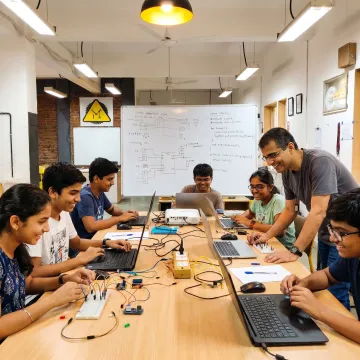
An innovation club in school is a structured extracurricular or enrichment program where students learn by designing, building, testing, and improving real projects. Instead of only studying concepts in theory, students engage with tools, materials, electronics, design software, and collaborative challenges. The goal is to develop creativity, problem-solving, teamwork, and practical STEAM skills through hands-on experiential learning.
Who are school innovation clubs best suited for?
School innovation clubs work especially well for students in middle and secondary grades who benefit from applied, project-based learning. They are ideal for schools that want to strengthen STEAM exposure, design thinking, and future-readiness without relying only on conventional classroom instruction. Programs can be adapted for beginners, and no advanced technical background is required to get started.
What kinds of activities can students do in an innovation club?
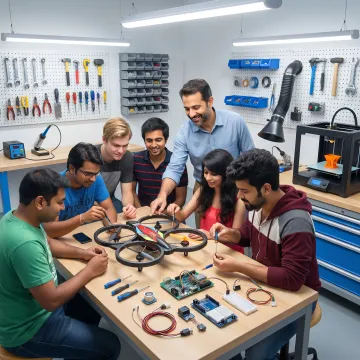
Students can work on activities such as CAD design, electronics, IoT builds, laser cutting, 3D printing, woodworking, robotics concepts, and prototype development. Many projects involve solving real-world problems, documenting the process, and presenting outcomes. This variety helps schools create a club experience that balances creativity, technical skill-building, and collaborative learning.
Do students need prior technical experience to join?
No. Maker's Asylum programs are designed to welcome curious learners, including complete beginners. Students are introduced to tools, workflows, and concepts step by step through guided mentorship and project-based tasks. The emphasis is on curiosity, experimentation, and learning through doing, so students can build confidence even if they have never worked with hardware, design tools, or fabrication before.
How are innovation clubs different from regular classroom learning?
Regular classroom learning often focuses on theory, fixed answers, and subject-based instruction, while innovation clubs emphasize experimentation, iteration, and interdisciplinary problem-solving. Students learn by making prototypes, testing ideas, and reflecting on outcomes. This approach strengthens practical understanding, communication, teamwork, and resilience, making learning more engaging and memorable for many students.
Can schools choose specific modules for their club program?
Yes. Schools can build a club around modular offerings such as CAD, electronics, PCB design, IoT, woodworking, drone engineering, virtual reality, or digital fabrication. This flexibility allows schools to match the club to student age groups, available time, and learning goals. Programs can be introduced as standalone modules or combined into a broader experiential learning pathway.
What outcomes can schools expect from an innovation club?
Schools can expect visible student outcomes such as functional prototypes, stronger collaboration, improved confidence with tools and technology, and better documentation of project work. Students also gain exposure to design thinking, problem-solving, and portfolio-building practices that support future academic and career pathways. For many schools, the club becomes a practical bridge between curriculum and real-world application.
How long does it take to run a school innovation club?
The duration can vary based on the format selected. Some modules are short-term, such as 10-hour live programs recommended at 2-3 hours per week, while broader pathways like Innovation School extend over several months. Schools can choose a format that fits their calendar, enrichment schedule, or holiday programming while still ensuring students complete meaningful hands-on work.