Introduction
Automation, AI, and data-driven technologies are reshaping what it means to work — and what it takes to succeed. Students who can think across disciplines and build real solutions will have a clear edge. According to the World Economic Forum's Future of Jobs Report 2025, 70% of companies rank analytical thinking as the top core skill globally.
Yet STEM education is often treated as an abstract concept rather than a practical tool. Its real value shows up in how students think, collaborate, and prepare for careers that may not exist yet.
Employers expect 39% of workers' core skills to change by 2030. That makes adaptability and hands-on problem-solving less of a bonus — and more of a baseline. Here's what students actually gain from meaningful STEM engagement.
Key Takeaways
- STEM education builds critical thinking, problem-solving, and technical skills that apply across virtually every career path
- Hands-on, project-based learning makes abstract concepts relevant and applicable to real-world challenges
- Students develop collaboration, communication, and resilience—skills that transfer far beyond the classroom
- STEM careers are among the fastest-growing and highest-paying globally, with top roles in India commanding annual packages well above ₹20,00,000
- Early exposure to applied, maker-style STEM learning gives students a measurable edge in university admissions and career readiness
What Is STEM Education?
STEM is an integrated approach to teaching Science, Technology, Engineering, and Mathematics—not as four separate subjects, but as interconnected disciplines applied together to solve real-world problems. UNESCO defines STEM education as "an interdisciplinary approach to teaching that integrates the basic sciences, technology, engineering, and mathematics." The National Science Teaching Association (NSTA) emphasises that STEM "is not simply a new name for the cost-sharing of these four disciplines" but "requires an integrated approach to teaching and learning."
Many modern programmes also include Arts (STEAM), adding design thinking and creative problem-solving to the mix. This expansion emerged around 2006 and gained traction through advocates like John Maeda, who championed the "STEM to STEAM" initiative during his tenure at the Rhode Island School of Design from 2008 to 2013.
STEM education is not reserved for elite schools or future scientists. It works across middle school through college, in classrooms, makerspaces, and online environments alike — relevant to any student, regardless of where they're headed.
The real goal is to build learners who can:
- Think critically when faced with unfamiliar problems
- Collaborate across disciplines and perspectives
- Adapt confidently as the job market shifts with automation and AI
- Apply knowledge to real situations, not just pass tests
Key Benefits of STEM Education for Students
The benefits of STEM education extend well beyond test scores or subject knowledge. They compound across academic performance, career preparedness, and life skills, becoming most visible in how students approach challenges outside the classroom.
Critical Thinking and Problem-Solving
STEM education pushes students beyond memorisation into open-ended problem-solving. They learn to hypothesise, test, and iterate across disciplines — not in silos. Students trained this way approach unfamiliar challenges systematically, evaluating evidence critically rather than settling for surface-level answers.
Research published in Heliyon studied 600 high school students where mathematics was taught using project-based learning over six weeks. The study found statistically significant improvements in critical thinking skills, with the model explaining 50% of variance in student engagement. Students in project-based STEM learning programmes consistently demonstrate stronger understanding and engagement than those in traditional instruction models.
The WEF Future of Jobs 2025 report confirms that 70% of companies rate analytical thinking as the number one core skill globally. A student who can analyse a problem from multiple angles is better equipped for higher education, complex workplaces, and everyday decision-making. In an era of AI-generated content and widespread misinformation, that ability to question assumptions and reason through complexity isn't just academically useful — it's a survival skill.
Career Readiness and Future Workforce Opportunities
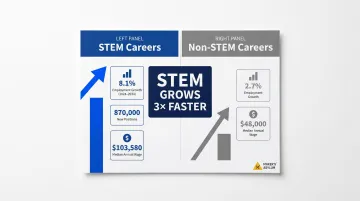
STEM education directly prepares students for some of the fastest-growing and highest-paying careers globally. The U.S. Bureau of Labor Statistics (BLS) projects that STEM employment will grow 8.1% from 2024 to 2034 — exactly three times faster than the 2.7% growth rate for non-STEM occupations. This growth will add approximately 870,000 new STEM positions over the decade.
The wage premium is equally striking. According to BLS data, STEM workers in the US earn a median of $103,580 annually versus $48,000 for non-STEM occupations — more than double. Georgetown University's Center on Education and the Workforce reports that STEM bachelor's degree holders earn a median of $98,000 compared to $48,000 in education and public service fields.
Students with a STEM foundation are not locked into a single career path. Technical fluency, analytical thinking, and adaptability make them competitive across a wide range of roles — including fields not traditionally considered "STEM," from healthcare to finance to media. They also graduate with portfolios of real projects that universities and employers increasingly value alongside grades.
With automation reshaping entry-level roles, students who can create, design, and problem-solve will be far more resilient than those executing repetitive tasks. The Lightcast Digital Skills Outlook 2024 reports that 92% of jobs now require at least some digital skills, making STEM literacy relevant across virtually every industry.
Hands-On Learning and Real-World Application
One of the defining characteristics of effective STEM education is its emphasis on doing rather than just learning. Students work on projects connected to real challenges, building prototypes, running experiments, and testing ideas in environments that mirror how professionals actually work.
A 20-year meta-analysis by Chen and Krajcik found that project-based learning yields a mean effect size of 0.71 on student academic achievement — a medium-to-large impact. This robust evidence demonstrates that hands-on, project-based learning dramatically increases student engagement and retention compared to traditional instruction models.
Programmes that embody this principle — such as Maker's Asylum's Innovation School — demonstrate what real-world STEM application looks like. Students work on interdisciplinary STEAM projects, solve genuine problems, and build tangible portfolios rather than accumulating grades on transcripts. This "Learning by Making" and "Make, Break, Create" philosophy creates safe spaces for experimentation where failure becomes a valuable learning opportunity.
Universities and top employers increasingly value demonstrated skills and project portfolios over grades alone. Students who have built real things — and documented their process — hold a meaningful advantage in both admissions and hiring. Showing a functional prototype and walking through design decisions communicates competency far more effectively than a transcript.
Collaboration, Communication, and Resilience
STEM projects are almost never solo endeavours. Students work in teams, share responsibilities, pitch ideas, debate approaches, and present outcomes — naturally developing the collaboration and communication skills that employers consistently flag as critical across industries.
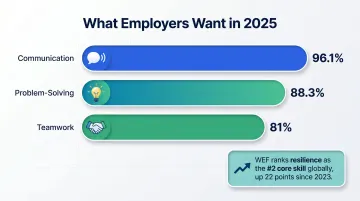
The NACE Job Outlook 2025 puts hard numbers on what employers actually want:
- 96.1% rate communication as very or extremely important
- 88.3% seek problem-solving skills
- 81% prioritise the ability to work in a team
These aren't generic soft skills — they are the core competencies that determine professional success.
Resilience is built through the iterative nature of STEM work. Students learn that failure is part of the process — a hypothesis that doesn't hold up, a prototype that breaks, code that crashes. Iterating through failure leads to stronger outcomes. The WEF Future of Jobs 2025 ranks resilience, flexibility, and agility as the second most important core skill globally, with importance ratings rising by 22 percentage points since 2023 — the largest increase of any skill.
Research on resilience in STEM contexts studied 4,936 UK secondary students and found that among those who found STEM lessons difficult, the difference in negative emotion between high-resilient and low-resilient students showed a large effect size. The study confirmed that teacher support and domain-specific interventions are critical in building STEM resilience.
The ability to work in teams, communicate complex ideas clearly, and persist through setbacks applies in every professional context — from university group projects to startup pitches to workplace dynamics. STEM education builds these habits early, when they matter most.
What Happens When STEM Education Is Skipped or Undervalued
Students who miss out on quality STEM education face significant downstream consequences. They are more likely to find advanced coursework in science and mathematics inaccessible, less likely to pursue high-growth careers, and less prepared to navigate a technology-driven world with confidence.
The ACT 2024 National Graduating Class Profile Report confirms that just 15% of 1,374,791 tested students met the STEM readiness benchmark for college-level coursework. This means 85% of tested graduates did not demonstrate readiness for STEM pathways, severely limiting their access to high-paying careers and technical education opportunities.
The equity dimension is particularly stark. The National Academies of Sciences, Engineering, and Medicine (2025) report documents severe access disparities:
- 87% of low-poverty schools offer calculus versus only 45% of high-poverty schools
- 93% of low-poverty schools offer advanced mathematics versus 71% of high-poverty schools
- AP Mathematics completion rates: 46% for Asian students, 17% for white students, 12% for Latinx students, and 6% for Black students
Students from underserved communities are disproportionately affected when STEM programs are absent or underfunded. Without early exposure and equitable access, the gap between those who can participate in the innovation economy and those who cannot keeps widening — and closing it becomes harder with each generation.
How to Make the Most of STEM Education
STEM education delivers its full value as an ongoing practice — building, experimenting, and improving over time, not a subject checked off once. Students get the most from it when they're actively making and problem-solving, not passively absorbing content.
The best STEM experiences combine structured learning with open exploration. This includes:
- Mentorship from practitioners with real-world experience
- Access to actual tools and equipment for hands-on fabrication
- Exposure to projects connected to genuine societal problems
- Documentation of the entire process from ideation to prototype
Programs like Maker's Asylum's Innovation School are built around exactly this model — combining skills training in CAD design, electronics, robotics, and digital fabrication with intensive residencies where students build functional prototypes for real-world challenges.
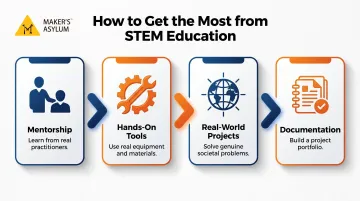
Every project completed and every prototype documented becomes evidence of capability. Universities and employers increasingly want to see what students have built and how they solved problems — that's a portfolio, and it carries weight that grades alone cannot.
Conclusion
The benefits of STEM education are both immediate and long-term. Students gain critical thinking skills, career readiness, hands-on confidence, and the resilience to keep trying when things go wrong. These are tangible advantages that compound over time, shaping how students approach challenges long after the classroom.
STEM education is most powerful when it is consistent, applied, and connected to real challenges—not treated as a single subject or a one-time enrichment activity. The students who learn to think across disciplines, work with their hands, and iterate through failure are the ones most equipped to drive what comes next. That's the philosophy behind programs like Maker's Asylum's Innovation School — where STEAM education isn't a subject but a practice, applied to real problems from day one.
Frequently Asked Questions
What is STEM education in schools?
STEM education in schools is an integrated approach to teaching Science, Technology, Engineering, and Mathematics through hands-on, project-based learning. Rather than treating these as separate subjects, STEM connects them to each other and to real-world challenges, developing practical problem-solving skills alongside core academic knowledge.
What are the benefits of STEM education for students?
Key benefits include critical thinking and analytical skills, career readiness for high-growth industries, hands-on problem-solving confidence, collaboration and communication abilities, and resilience through iterative learning. These skills develop through doing and making, not passive study.
Is STEM education better than traditional schooling?
STEM education is not necessarily "better" but is more aligned with the skills modern students need. It complements core academics with applied problem-solving, hands-on creation, and interdisciplinary thinking. The quality of any programme matters more than the label; effective STEM emphasises real-world application over passive instruction.
What is the best age to start STEM education?
Exposure to STEM concepts can begin as early as primary school through age-appropriate activities. However, the most impactful structured STEM learning often begins in middle school (around ages 11-13), when students are developmentally ready to engage with open-ended problem-solving, hands-on projects, and collaborative design thinking.
What are the best careers in STEM?
High-growth STEM careers include software development, data science, biomedical engineering, robotics, environmental science, AI research, and information security. STEM skills also increasingly open doors in non-traditional fields like design, media, finance, and healthcare, where technical literacy and analytical thinking are becoming essential.
Is STEM education good for students with ADHD?
STEM education's hands-on, project-based nature suits students with ADHD well, replacing passive instruction with active, engaging tasks. Students who struggle in traditional settings often thrive when given the freedom to build, test, and explore through maker-style STEM programmes.