Are these electronic product design courses suitable for complete beginners?
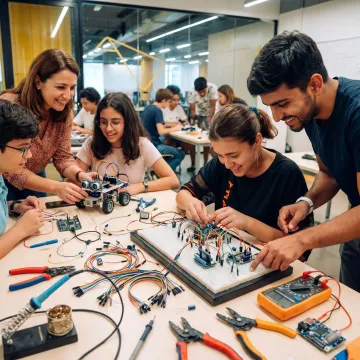
Yes. Maker's Asylum offers beginner-friendly courses designed for students and first-time learners with no technical background required. Programs start with fundamentals such as components, circuits, sensors, and basic programming, then gradually move into applied skills like PCB design, IoT projects, CAD, and prototyping. The hands-on format makes concepts easier to understand and retain.
What will students learn in an electronic product design course?
Students learn how to move from an idea to a working prototype. Depending on the course, this can include electronics basics, microcontroller programming, PCB design, IoT systems, CAD modeling, soldering, and digital fabrication. The emphasis is on building real projects, understanding how parts work together, and developing practical design thinking for hardware products.
Do I need coding experience to join?
No prior coding experience is needed for beginner-level courses. Learners are introduced to programming through guided exercises tied to physical projects, such as using sensors, lights, and microcontrollers. This approach helps students understand code in context rather than as abstract theory, making it more approachable for beginners and younger learners.
Which course is best for someone interested in building electronic products?
For beginners, the Electronics and Micro-controllers course is a strong starting point because it covers core circuit and programming concepts. PCB Design is ideal for learners ready to understand manufacturable electronics, while IoT adds connected-device skills. Students seeking a broader pathway can consider Innovation School for a more comprehensive pre-engineering and portfolio-building experience.
How are the courses taught?
Courses are taught in hands-on formats that may be live, online, offline, or hybrid depending on the program. Many Maker Skills courses run for 10 hours with a flexible schedule and project-based learning supported by hardware kits sent home. Innovation School combines self-paced learning, mentorship, group sessions, and an onsite immersion experience for deeper engagement.
Will students build real projects during the course?
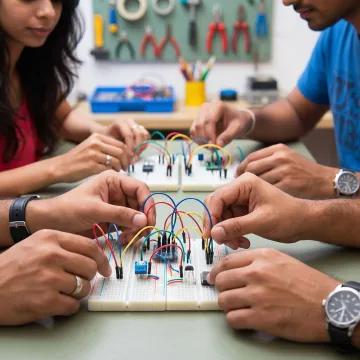
Yes. Project-based learning is central to Maker's Asylum's approach. Learners work on guided builds using hardware kits, sensors, microcontrollers, and fabrication tools to create functional prototypes rather than only completing worksheets or passive lessons. This helps students develop technical confidence, understand product workflows, and document meaningful work for future portfolios.
Can these courses help with college portfolios or future STEM pathways?
Yes. Hands-on electronic product design projects can strengthen a student's portfolio by showing initiative, technical curiosity, and problem-solving ability. Maker's Asylum specifically emphasizes project documentation and real-world making, and Innovation School is designed to support college-ready portfolios. These experiences are especially valuable for students exploring engineering, design, robotics, or interdisciplinary STEM fields.
How much time do beginners need to commit?
Most Maker Skills courses are structured to be manageable for students, with a recommended commitment of 2 to 3 hours per week and a total duration of 10 hours. For learners seeking a deeper experience, Innovation School runs over 6 months with 120 total hours that include self-paced learning, mentorship, and immersion-based project development.